
Mallophora bomboides
(Wiedemann, 1821)
Florida Bee-Killer, Florida bee killer
Mallophora bomboides is a predatory robber fly ( Asilidae) native to the southeastern United States. It is notable for its specialized on bumblebees and its remarkable of its prey, particularly Bombus pensylvanicus. The has been extensively studied as a classic example of mimicry, with experimental work demonstrating that learn to avoid the unpalatable bumblebee model and consequently avoid the palatable fly mimic. are active from spring through late fall, with peak abundance in late summer.


Pronunciation
How to pronounce Mallophora bomboides: /mæˈlɒfərə bɒmˈbɔɪdiːz/
These audio files are automatically generated. While they are not always 100% accurate, they are a good starting point.
Identification
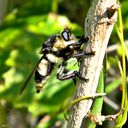
Distinguished from other robber flies by its specific resemblance to bumblebees, particularly Bombus pensylvanicus. The combination of yellow-haired basal abdominal tergites, black-haired middle tergites (fourth and fifth), and pale-haired terminal segments creates a color pattern matching its prey. The dense hair covering and robust body form differ from most other Asilidae. Can be separated from actual bumblebees by the single pair of wings (Diptera), large that meet at the top of the , and the characteristic predatory posture of robber flies.
Images
Habitat
inhabit open , often in proximity to or areas with abundant bumblebee . They perch vertically angled on weed stalks or shrub tips from which they launch attacks on prey. The shows affinity for habitats where its bumblebee prey is abundant, ensuring sympatry necessary for the mimicry system to function.
Distribution
Southeastern United States, including North Carolina, South Carolina, Georgia, Florida, Alabama, and Mississippi.
Seasonality
period extends from April through December in Florida, with peak activity and abundance in late summer.
Diet
prey primarily on bumblebees, especially Bombus pensylvanicus (formerly B. americanorum). As a member of Asilidae, it may also take other Hymenoptera. Larval feeding habits are unknown, though related Mallophora are on scarabaeid larvae in soil.
Host Associations
- Bombus pensylvanicus - primary prey and mimetic model system; fly gains protection from that learn to avoid the unpalatable, stinging bumblebee
Life Cycle
are laid in soil. Larval is poorly known; specific feeding habits of M. bomboides larvae have not been documented, though congeneric larvae are on scarabaeid larvae. and activity spans spring through late fall.
Behavior
are sit-and-wait that perch on elevated vegetation and launch swift attacks on passing bumblebees. The resemblance to prey may enhance hunting success by allowing closer approach before detection. Perching posture is characteristically vertical on plant stems. Experimental evidence indicates that the mimicry provides protection from predators such as toads (Bufo terrestris), which learn to visually reject bumblebees and consequently avoid the mimetic fly.
Ecological Role
of bumblebees and other Hymenoptera. Participant in a documented system where it gains protection from predators by resembling unpalatable prey. Potential economic impact as a pest of managed colonies in some areas, though primarily associated with wild bumblebee .
Human Relevance
Documented as a cause of economic losses to beekeepers in Florida, one of few states where such losses have been reported as noteworthy. A 2008 incident at Little Lake City, Florida involved hundreds of individuals attacking hives. The serves as a classic research subject for studies of mimicry, learning, and evolutionary .
Similar Taxa
- Bombus pensylvanicusThe bumblebee model and primary prey; M. bomboides is a Batesian mimic with highly specific resemblance in coloration, hair pattern, and body form
- Other Mallophora speciesCongeneric robber flies with similar predatory habits on Hymenoptera; distinguished by specific prey associations and color pattern details
- Volucella hoverfliesAlso Batesian mimics of bumblebees, but belong to different order (Diptera: Syrphidae) with different and less specialized predatory
Misconceptions
Originally classified by Poulton in 1890 as , the resemblance was reclassified as protective (Batesian) mimicry following criticism by Bateson and experimental demonstration by Brower et al. in 1960. The hypothesis that females enter bumblebee nests to lay , with larvae consuming , remains speculative and unsupported by direct observation.
More Details
Mimicry research history
Subject of foundational experimental work on by Lincoln Brower and colleagues in 1960, using toads (Bufo terrestris) as to demonstrate learned avoidance. Earlier work by Carpenter (1921) and Morgan (1896) with primates and birds established the protective function of the resemblance. The system meets all prerequisites for stable Batesian mimicry: sympatry of model and mimic, models outnumber mimics, and models possess conspicuous aposematic coloration advertising their noxious sting.
Nomenclature note
The bumblebee model has undergone taxonomic revision; originally referenced as Bombus americanorum, now recognized as Bombus pensylvanicus.
Sources and further reading
- BugGuide
- Wikipedia
- GBIF taxonomy match
- iNaturalist taxon
- Catalogue of Life
- Congratulations, Microbiologist Shawn Christensen: Best Dissertation | Bug Squad
- Digging the Digger Bees and the Newly Published Research | Bug Squad
- UC Davis: All A'Buzz With Bee Nests and Art | Bug Squad
- A Silver Digger Bee in Flight at Bodega Head | Bug Squad
- The Beckoning Bees at Bodega Bay | Bug Squad
- The Glory of the Bindweed Turret Bees | Bug Squad