
Eulonchus smaragdinus
Gerstaecker, 1856
Jewelled spider fly
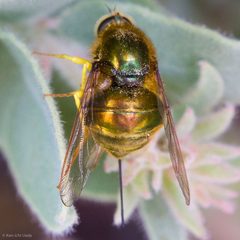
Eulonchus smaragdinus is a of small-headed fly in the Acroceridae, commonly known as jewelled spider flies. are brilliantly metallic green to blue, with large rounded bodies covered in dense hairs. The species is an important of flowers, feeding on nectar from numerous plant families with its greatly elongated mouthparts. Its larvae are of tarantulas, developing inside the spider and eventually killing it.
Pronunciation
How to pronounce Eulonchus smaragdinus: /juːˈlɒŋkəs sməˈræɡdɪnəs/
These audio files are automatically generated. While they are not always 100% accurate, they are a good starting point.
Identification
Distinguished from other tarantula flies by combination of metallic green-blue coloration, large rounded hairy body, greatly elongated mouthparts, and soft-haired . Among the six North American Eulonchus , E. smaragdinus is one of five western species ranging from Mexico to Canada, separated from the single eastern species E. marialiciae found in the Great Smoky Mountains.
Images
Habitat
Mountainous areas of western North America, particularly the Sierra Nevada of California. associated with flowering plants; larvae occur within tarantula .
Distribution
Western North America, from Mexico to Canada. Locally abundant in the Sierra Nevada of California.
Diet
feed on nectar from flowers of more than 25 plant and 80 . Larvae are internal of tarantulas, consuming tissues.
Host Associations
- Tarantulas (Theraphosidae) - Larvae seek out tarantula , insert themselves into the spider, and feed internally until mature, then burst out of the killing the spider
Life Cycle
Females lay that hatch into highly mobile larvae. Larvae actively seek spider , climb up the host's leg and burrow into the body wall, taking up residence around the book lungs. The larva feeds internally on host tissues until mature, then emerges from the spider's , killing the host. After , the larva pupates to develop into .
Behavior
are important , visiting flowers to feed on nectar with elongated mouthparts. Larvae are active -seekers, capable of locating and parasitizing tarantulas.
Ecological Role
function as for diverse flowering plants. Larvae act as regulating tarantula .
Similar Taxa
- Other Eulonchus speciesSix recognized in North America; E. smaragdinus distinguished by specific coloration and distribution in western North America versus E. marialiciae in eastern mountains
- Other AcroceridaeEulonchus separated from other tarantula flies by metallic coloration, body shape, and characteristics
More Details
Taxonomic revision
redescribed in 2016 using cybertaxonomic methods by Borkent, Gillung, and Winterton. Study dedicated to Dr. Evert I. Schlinger (1928-2014), world-renowned expert on spider fly whose collection at California Academy of Sciences formed major part of examined material.