
Eulonchus marginatus
Osten Sacken, 1877
jewelled spider fly
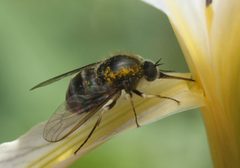
Eulonchus marginatus is a of small-headed fly in the Acroceridae, commonly known as a jewelled spider fly. The species has a Nearctic distribution and is known to visit flowers from over ten different plant families. Like other members of the , exhibit metallic coloration and serve as , while larvae are of spiders.
Pronunciation
How to pronounce Eulonchus marginatus: /juːˈlɒŋkəs mɑːrdʒɪˈneɪtəs/
These audio files are automatically generated. While they are not always 100% accurate, they are a good starting point.
Identification
Distinguished from other tarantula flies by the combination of elongated mouthparts, metallic green to blue or purple coloration, and covered with soft hairs. The large, rounded, densely hairy body with metallic sheen separates Eulonchus from other Acroceridae . Within the genus, E. marginatus is one of six recognized North American ; precise identification to species level requires examination of morphological details described in taxonomic revisions.
Images
Appearance
have large, rounded bodies covered with dense hairs and exhibit metallic coloration—green to blue or purple—giving a jewel-like appearance. The mouthparts are greatly elongated, adapted for feeding on nectar. The are covered with soft hairs.
Habitat
Found in mountainous areas of western North America, where it can be locally abundant. Associated with supporting both flowering plants for nectar feeding and spider for larval development.
Distribution
Nearctic distribution. Found in western North America, ranging from Mexico to Canada. One of six Eulonchus recognized in North America, with the majority of species occurring in the West.
Diet
feed on nectar from flowers of more than 25 different plant and 80 . Larvae are internal of spiders, feeding on tissues until mature.
Host Associations
- spiders - larval Larvae seek out tarantula , burrow into the body, and feed internally until mature, eventually emerging and killing the host
Life Cycle
Females lay that hatch into highly mobile, -seeking larvae. Larvae actively search for spider hosts, climb onto them, and burrow into the body wall, typically taking up residence around the book lungs. They feed internally on the host until mature, then emerge from the , killing the spider. After , they pupate to develop into .
Behavior
are important , visiting flowers from diverse plant . Larvae exhibit active -seeking , functioning as mobile that locate and infiltrate spider hosts.
Ecological Role
serve as for a broad range of flowering plants. Larvae function as , regulating spider . The represents part of a specialized -prey interaction within .
Similar Taxa
- other Eulonchus speciesshare metallic coloration, rounded hairy bodies, and elongated mouthparts; require detailed morphological examination for separation
- other Acroceridae generaEulonchus distinguished by combination of metallic coloration, soft-haired , and greatly elongated mouthparts
More Details
Taxonomic revision
The was redescribed as part of a 2016 cybertaxonomic revision of North American Eulonchus, which recognized six species in the and presented a phylogenetic analysis of species relationships.