
Haplandrus
LeConte, 1862
Species Guides
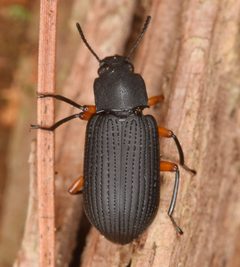
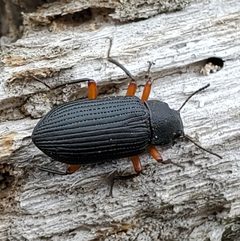
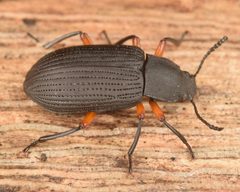
1Haplandrus is a of darkling beetles ( Tenebrionidae) established by John Lawrence LeConte in 1862. The genus is native to North America and contains multiple of small to medium-sized beetles. Based on iNaturalist records, the genus has been documented in approximately 359 observations, indicating moderate but not extensive field documentation. Species within this genus are part of the diverse tenebrionid fauna of arid and semi-arid regions.
Pronunciation
How to pronounce Haplandrus: //hæpˈlændrəs//
These audio files are automatically generated. While they are not always 100% accurate, they are a good starting point.
Identification
Haplandrus can be distinguished from other small Tenebrionidae by a combination of: body form moderately elongate; pronotum usually subquadrate to slightly transverse; with distinct or punctate- ; with 11 segments and a weakly to moderately clubbed terminal segment. The genus lacks the strongly explanate (flanged) lateral pronotal margins seen in some related genera, and the tarsal formula is 5-5-4. Examination of male genitalia is often required for definitive species-level identification within the genus.
Images
Distribution
North America, with occurring primarily in the southwestern United States and adjacent regions of Mexico. The appears to be centered in arid and semi-arid zones of the American Southwest.
Similar Taxa
- TenebrioBoth are small to medium Tenebrionidae with somewhat similar body form, but Tenebrio has more robust, rounded body shape, shorter relative to , and is primarily Old World in distribution with different antennal club structure.
- TriboliumSimilar size and general appearance, but Tribolium have more convex body form, often with characteristic 'confused' or 'smooth' elytral patterns, and are primarily associated with stored products rather than native arid .
- EleodesBoth are North American desert tenebrionids, but Eleodes are generally larger, have more elongate legs, and many species exhibit the characteristic '-standing' defensive posture; Eleodes also typically has more prominent elytral or different surface .
More Details
Taxonomic History
The was established by LeConte in 1862 based on specimens from the southwestern United States. The type and precise limits of the genus have been subject to revision, as is common for 19th-century tenebrionid genera. Modern phylogenetic studies of Tenebrionidae have not yet fully resolved the placement of Haplandrus within classifications.
Research Gaps
Despite being established over 160 years ago, Haplandrus remains relatively poorly studied in modern literature. -level , larval , and ecological studies are limited. The iNaturalist observation count (359) suggests potential for citizen science contributions to understanding distribution and .