
Cynaeus
LeConte, 1862
Species Guides
2- Cynaeus angustus(Larger Black Flour Beetle)
- Cynaeus depressus
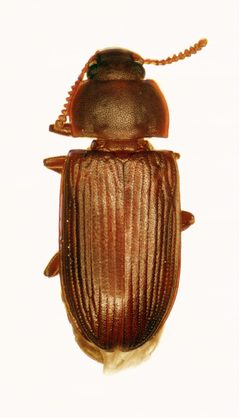
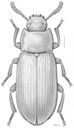
Cynaeus is a of darkling beetles in the Tenebrionidae. The genus includes at least one economically significant , Cynaeus angustus, commonly known as the larger black flour beetle. This species is native to North America and has become established as an pest across Europe and Russia. Members of this genus are associated with stored grain products and have been documented as pests of corn, wheat, sorghum, soybeans, and peanuts.
Pronunciation
How to pronounce Cynaeus: /sɪˈneɪ.əs/
These audio files are automatically generated. While they are not always 100% accurate, they are a good starting point.
Images
Habitat
Stored grain environments; facilities handling cereal products and oilseeds. Cynaeus angustus has been collected along river corridors in Europe, including sites along the Danube River in Bulgaria.
Distribution
Native to North America. Introduced and established in Europe: recorded in Denmark, Norway, Sweden, Romania, Bulgaria, Russia (Belgorod Province), and Ukraine (Lugansk and Kharkov Provinces).
Diet
Stored grain products including corn, wheat, sorghum, soybeans, and peanuts.
Life Cycle
Complete with documented stages: larva, pupa, and . Development is continuous under favorable conditions with high initial survival rates.
Ecological Role
Pest of stored grain products. Potential nutritional source; protein content increases through development (larvae 38.22 mg/mL, pupae 47.53 mg/mL, 60.00 mg/mL).
Human Relevance
Economic pest of stored grain and oilseed products. Subject to control measures in storage facilities. Investigated as a potential source of protein for .
Sources and further reading
- BugGuide
- Wikipedia
- GBIF taxonomy match
- iNaturalist taxon
- NCBI Taxonomy
- Cynaeus angustus (Coleoptera: Tenebrionidae), a new alien beetle in Romania
- Host-parasite relationship between Cynaeus angustus Lec. and Nosema cynaea Sp. Nov.
- Avaliação proteica e parâmetros populacionais de Cynaeus angustus Le Conte (Coleoptera: Tenebrionidae)
- Geographical Distribution of Cynaeus angustus (LeConte) (Coleoptera: Tenebrionidae) and its Association with Stored Products
- First record of the invasive alien species Cynaeus angustus (LeConte, 1851) (Coleoptera, Tenebrionidae) in Bulgaria
- Predicting current and future potential distribution of Cynaeus angustus (Coleoptera: Tenebrionidae) in global scale using the MaxEnt model
- First record of the larger black flour beetle (Cynaeus angustus) (Coleoptera: Tenebrionidae) from Russia, with a review of its North American and trans-continental expansion