
Eleodes osculans
(LeConte, 1851)
Woolly Darkling Beetle, Woolly Ground Beetle
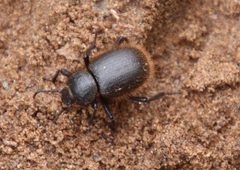
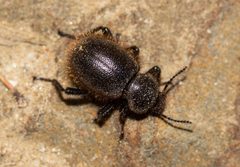
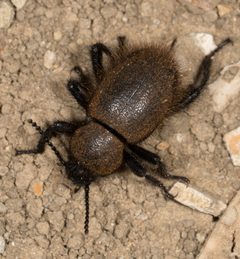
Eleodes osculans is a distinctive darkling beetle native to coastal California and Baja California, recognized by its unique covering of reddish-brown hair over a black . The is one of few North American darkling beetles with visible setation, and the only Eleodes species with this particular color combination. Like other members of its , it exhibits the characteristic defensive -standing posture when disturbed. It is primarily and inhabits wooded areas and chaparral .
Pronunciation
How to pronounce Eleodes osculans: /ɛˈliː.o.dɛs ˈɒs.kjʊ.lænz/
These audio files are automatically generated. While they are not always 100% accurate, they are a good starting point.
Identification
The combination of reddish-brown hair over black is unique among North American Eleodes and serves as the primary diagnostic character. Similar species Eleodes nigropilosa and Eleodes littoralis possess darker, blackish or grayish hair rather than the distinctive reddish-brown hair of E. osculans. The -standing defensive posture, while characteristic of the Eleodes, is not species-specific. are (bead-like), distinguishing the from ground beetles (Carabidae) which have more antennae. are concealed beneath the , not exposed as in predatory ground beetles.
Images
Habitat
Occurs in wooded areas and chaparral vegetation in coastal regions. Found in terrestrial with cover such as leaf litter, soil surface, and under debris. The is associated with Mediterranean-type climate characterized by dry summers and mild, wet winters.
Distribution
Coastal southern and central California, extending south into Baja California, Mexico. Distribution is restricted to the Pacific coastal zone and adjacent interior foothills, with records from California chaparral and oak woodland .
Seasonality
Active year-round in suitable , with peak activity likely during cooler, moister periods. As a , activity occurs primarily after dark.
Behavior
in activity pattern. When disturbed, raises the end of the body in a -standing posture and secretes defensive compounds from abdominal glands. This defensive posture is readily observable and characteristic of the Eleodes. The moves slowly under normal conditions, not exhibiting the rapid running typical of ground beetles.
Ecological Role
Functions as a in coastal woodland and chaparral , contributing to decomposition processes. As a chemically defended insect, it serves as a potential model for mimicry complexes, though specific mimicry relationships have not been documented for this .
Human Relevance
Occasionally encountered by hikers and naturalists in coastal California; the defensive secretion can be unpleasant but is not harmful. The distinctive appearance makes it a recognizable insect for amateur entomologists. No significant economic importance.
Similar Taxa
- Eleodes nigropilosaSimilar size and body form with hairy covering, but possesses darker black or grayish hair rather than the reddish-brown hair of E. osculans
- Eleodes littoralisOverlaps in and geographic range, but has darker hair coloration and lacks the distinctive reddish-brown setation
More Details
Taxonomic Note
Originally described as Amphidora osculans by LeConte in 1851, later transferred to Eleodes. The specific epithet and original genus placement reflect early 19th century darkling beetle .
Setation Uniqueness
Among approximately 200+ North American Eleodes , E. osculans is the only one documented with this particular reddish-brown hair coloration over black , making it perhaps the most easily identified species in the based on gross alone.