
Prostomis
Latreille, 1819
Species Guides
1Prostomis is a of beetles in the Prostomidae, established by Latreille in 1819. The genus contains at least 28 accepted distributed across multiple continents. Members of this genus are xylophilous (wood-associated) beetles with a documented fossil record extending to the mid-Holocene in Europe. The genus is considered rare in modern faunas, with some species no longer present in regions where they occurred historically.
Pronunciation
How to pronounce Prostomis: //proʊˈstoʊmɪs//
These audio files are automatically generated. While they are not always 100% accurate, they are a good starting point.
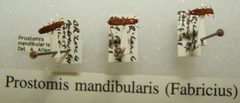
Images
Habitat
Woodland environments; specifically associated with tree rot-holes and decaying wood. Fossil evidence indicates association with Pinus (pine) woodland .
Distribution
Widespread but patchy: documented from Europe (including fossil records from eastern England), Africa, Asia (Japan, Taiwan, Philippines, Borneo), Australia, New Zealand, and Pacific islands (Samoa, Papua New Guinea). Modern records from Denmark and Norway confirmed.
Host Associations
- Pinus - associationBased on mid-Holocene fossil evidence from tree rot-holes in Pinus-dominated woodland; specific feeding relationship not established
Ecological Role
Member of xylophilous in forest ; presence in subfossil assemblages suggests long-term association with woodland and potential value as an indicator of ancient forest conditions.
Human Relevance
Paleontological significance: subfossil remains have been used in dendrochronological studies to reconstruct mid-Holocene forest composition and age structure. The serves as an indicator of long-term biodiversity in forest and mire conservation contexts.
More Details
Paleontological record
The has been recovered from subfossil insect in waterlogged deposits, providing evidence of former distributions. In eastern England, Prostomis was present in Pinus-dominated forests dated to 2921–2445 BC but no longer occurs in the British Isles.
Conservation status
Multiple are considered very rare in modern faunas. The disappearance of some species from parts of their former range has been linked to decline in woodland and possible climatic changes.