
Prostomidae
C.G. Thomson, 1859
jugular-horned beetles, Red Log Beetles
Genus Guides
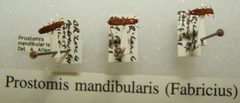
1is a small of beetles comprising two extant (Prostomis and Dryocora) with approximately 20 . These elongate, parallel-sided beetles are specialized inhabitants of dead wood, where both larvae and develop. The family exhibits a disjunct global distribution: Prostomis occurs in North America, Europe, Africa, the Pacific region and East Asia, while Dryocora is restricted to New Zealand, Australia and Tasmania. An extinct genus, Vetuprostomis, is known from mid-Cretaceous Burmese amber.
Pronunciation
How to pronounce Prostomidae: /prɒsˈtɒmɪdiː/
These audio files are automatically generated. While they are not always 100% accurate, they are a good starting point.
Identification
The combination of , large jugular process, small , and pronotum of equal width, and 4-4-4 tarsal formula distinguishes from other . The weakly clubbed (last three segments) and parallel-sided body form are additional diagnostic features. These beetles may be confused with other elongate wood-inhabiting beetles such as certain Cucujidae or Salpingidae, but the forward-facing mandibles and jugular process are unique to this family.
Images
Habitat
Fallen logs and dead wood, particularly the interior of decaying timber. Both larvae and occur mainly inside fallen logs.
Distribution
Disjunct distribution: Prostomis in North America, Europe, Africa, Pacific region and East Asia; Dryocora species in New Zealand, Australia and Tasmania. Distribution records from Denmark, Norway and Sweden (GBIF).
Diet
Larvae feed on rotten wood, particularly rotting heartwood of thick logs, and on mud-like matter in red-coloured decomposing wood.
Life Cycle
Larvae and develop within fallen logs. Specific developmental stages and duration unknown from available sources.
Behavior
Specialized for life within decaying wood; both life stages remain concealed inside logs.
Ecological Role
Decomposer in forest , contributing to wood decay and nutrient cycling through consumption of rotting heartwood.
Similar Taxa
- CucujidaeFlat bark beetles share elongate form and wood association, but lack and jugular process.
- SalpingidaeSome are elongate and wood-associated, but differ in structure and orientation.
- TenebrionidaeSome elongate occur in similar , but have different tarsal formula and lack the distinctive jugular process.
More Details
Extinct taxon
Vetuprostomis, an extinct , is known from several described from mid-Cretaceous Burmese amber in northern Myanmar. It is suggested to be more closely related to Dryocora than to Prostomis.
Taxonomic note
The has no historically established vernacular name; 'jugular-horned beetles' and 'Red Log Beetles' are recently coined names.