
Mycetophagus punctatus
Say, 1826
hairy fungus beetle, punctured hairy fungus beetle
Mycetophagus punctatus is a in the Mycetophagidae, commonly known as the hairy fungus beetle. It occurs throughout North America and is frequently found in human dwellings where damp conditions and decaying organic matter are present. The is not considered a pest as it does not cause damage to structures or stored products.
Pronunciation
How to pronounce Mycetophagus punctatus: /maɪˌsɛtəˈfæɡəs pʌŋkˈteɪtəs/
These audio files are automatically generated. While they are not always 100% accurate, they are a good starting point.
Identification
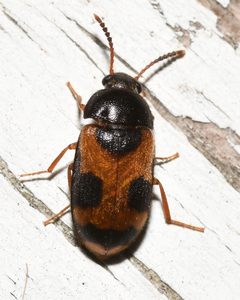
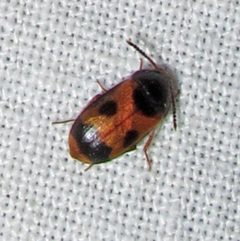
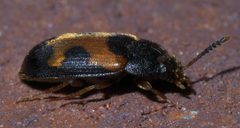
are 4.0–5.5 mm in body length with black bearing red-yellow markings. are red-brown, darkening to black at the tips. The body is covered with short hairs. The combination of punctate elytral pattern, hairy body, and antennal coloration distinguishes this from other Mycetophagus.
Images
Habitat
Moist environments with decaying organic matter, including cellars, houses around bathtubs or sinks, and areas with damp cereals, herbs, spices, cheese, fruit preserves, and fibers including carpet.
Distribution
North America, including Canada (Manitoba, New Brunswick) and the United States.
Seasonality
Proliferates during late summer to early fall.
Diet
Feeds on fungi growing on decaying plant material and damp organic substrates including cereals, herbs, spices, cheese, and fruit preserves.
Behavior
Attracted to light sources. Does not bite humans or spread .
Ecological Role
Decomposer; feeds on fungi associated with decaying organic matter.
Human Relevance
Occasionally found in households where damp conditions exist. Does not cause damage to structures or belongings. use is known to limit their presence.
Similar Taxa
- Other Mycetophagus speciesMay share general appearance and preferences; distinguished by specific elytral color patterns and punctation
- Other MycetophagidaeSimilar size and fungus-feeding ; identification requires examination of antennal structure and body punctation
Sources and further reading
- BugGuide
- Wikipedia
- GBIF taxonomy match
- iNaturalist taxon
- Catalogue of Life
- Bug Eric: Spider Sunday: Phidippus octopunctatus
- ID Challenge #18 | Beetles In The Bush
- Euonymus peril - Euonymus leaf notcher, Pryeria sinica — Bug of the Week
- Anne Arundel County - This Bug's for You: The Euonymus Leaf Notcher, Pryeria sinica — Bug of the Week
- Yet another exotic invader: Euonymus leaf notcher, Pryeria sinicia — Bug of the Week
- Bug of the Week