
Lytta tenebrosa
(LeConte, 1851)
Lytta tenebrosa is a blister beetle in the Meloidae, first described by LeConte in 1851. It is placed in the subgenus Paralytta within the Lytta. The is known from North America, with 92 specimens documented in the Entomology Research Museum collection. Like other members of its genus, it possesses chemical defenses including cantharidins.
Pronunciation
How to pronounce Lytta tenebrosa: //ˈlɪtə tɛnəˈbroʊsə//
These audio files are automatically generated. While they are not always 100% accurate, they are a good starting point.
Identification
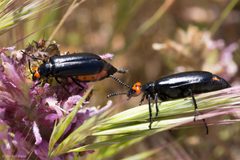
Lytta tenebrosa is classified in the subgenus Paralytta, which includes with generally robust bodies and variable coloration. Within this subgenus, it may be distinguished from closely related species such as L. vulnerata and L. magister by specific morphological features, though detailed diagnostic characters require examination of original descriptions. The species epithet "tenebrosa" (meaning dark or gloomy) suggests darker coloration compared to some .
Images
Distribution
North America. The has been documented in museum collections from the southwestern United States and Mexico, consistent with the distribution pattern of other Paralytta subgenus members.
Similar Taxa
- Lytta vulnerataBoth belong to subgenus Paralytta and share similar body forms; L. vulnerata is more widely distributed and variable, with some showing distinct elytral sculpturing
- Lytta magisterAnother large Paralytta with overlapping geographic range; L. magister is notably common in desert regions and may be distinguished by specific color patterns
More Details
Taxonomic placement
The is placed in subgenus Paralytta, one of several subgenera within the large Lytta. The genus Lytta contains approximately 70 described species primarily distributed in North America, with some species in the Palearctic region.
Specimen records
The Entomology Research Museum at the University of California, Riverside holds 92 specimens of L. tenebrosa as of April 2010, indicating it is moderately well-represented in collections compared to some .