
Lytta biguttata
LeConte, 1853
Two-spotted Lytta
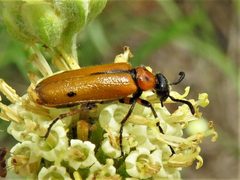
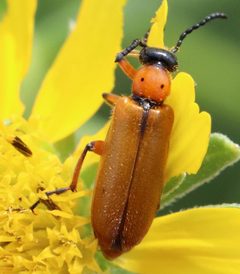
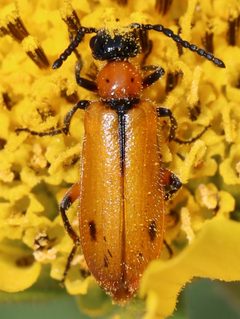
Lytta biguttata is a blister beetle in the Meloidae, placed in the subgenus Paralytta. The is found in arid and semi-arid regions of western North America and Central America. Like other meloids, it possesses chemical defenses and has been observed on flowers of Asteraceae, including Cirsium and yellow composite flowers.
Pronunciation
How to pronounce Lytta biguttata: /ˈlɪtə bɪˈɡʌtɑːtə/
These audio files are automatically generated. While they are not always 100% accurate, they are a good starting point.
Identification
Distinguished from other Lytta by the combination of two distinct pale or contrasting spots on the (referenced in the specific epithet 'biguttata', meaning 'two-spotted') and placement in the subgenus Paralytta. The subgenus Paralytta includes species with relatively robust body form compared to other Lytta subgenera. Accurate identification requires examination of male genitalia and comparison with related species such as L. magister and L. vulnerata.
Images
Habitat
Arid and semi-arid environments including desert scrub, grasslands, and open disturbed areas. Associated with flowering herbaceous vegetation, particularly Asteraceae. Has been collected at elevations ranging from low desert to montane areas in the southwestern United States.
Distribution
Documented from western Texas, southern New Mexico, and southeastern Arizona in the United States, extending southward through Mexico into Central America. GBIF records confirm presence in Middle America and North America. Museum holdings at the Entomology Research Museum (UCR) include 159 specimens, indicating it is moderately collected in the southwestern United States.
Seasonality
have been observed from July through August in the southwestern United States, with peak activity coinciding with summer monsoon rains and flowering of plants. The appears to be with adult timed to summer flowering periods.
Host Associations
- Cirsium sp. - flower visitorobserved on flowers
- Asteraceae (yellow composite flowers) - flower visitorobserved on unidentified yellow composite flowers
Behavior
are and have been observed visiting flowers, presumably for feeding on pollen and nectar. Like other blister beetles, it is likely to exhibit defensive when disturbed, releasing -containing . The has been found individually rather than in , unlike some sympatric meloids such as Epicauta costata.
Ecological Role
As a flower visitor, likely contributes to pollination of Asteraceae. The larvae are presumed to be or parasitic on ground-nesting bees or pods, following the typical meloid pattern, though this has not been directly documented for this .
Human Relevance
Like all blister beetles, contains and should be handled with caution to avoid skin blistering. Not known to be a significant agricultural pest. Of interest to coleopterists studying southwestern North American meloid diversity.
Similar Taxa
- Lytta magisterSympatric in southwestern deserts; larger size and different elytral pattern distinguish L. magister
- Lytta vulnerataAlso in subgenus Paralytta and sympatric; distinguished by elytral maculation and male genitalia
- Epicauta spp.Sympatric meloids that may occur on similar flowers; Epicauta generally have more elongate bodies and different antennal structure
More Details
Museum Holdings
The Entomology Research Museum at University of California, Riverside holds 159 specimens of Lytta biguttata as of 2010, indicating moderate abundance in collections and research interest.
Taxonomic History
Described by John Lawrence LeConte in 1853, the has remained in the Lytta with placement in subgenus Paralytta following modern revisions of the genus by Selander and others.