
Epicauta ventralis
Werner, 1945
Dark-spotted Blister Beetle
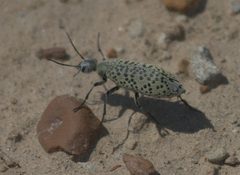
Epicauta ventralis is a of blister beetle in the Meloidae, first described by Werner in 1945. It belongs to the large Epicauta, which contains numerous North American species that are often difficult to distinguish. Like other blister beetles, it produces , a defensive chemical compound. The species has been documented in the western portions of North America.
Pronunciation
How to pronounce Epicauta ventralis: /ˌɛpɪˈkaʊtə vɛnˈtreɪlɪs/
These audio files are automatically generated. While they are not always 100% accurate, they are a good starting point.
Identification
Epicauta ventralis is one of many gray-colored Epicauta that require careful examination for positive identification. The specific epithet 'ventralis' suggests distinctive characteristics, though detailed diagnostic features are not well documented in available sources. Species in this are notoriously difficult to identify to species level from photographs or brief examination, often requiring dissection or reference to original descriptions. It can be distinguished from the very similar Epicauta vittata by subtle differences in elytral patterning and body proportions, though these differences are not consistently described in field guides.
Images
Distribution
Found in North America. Specific distribution records include the Canadian provinces of Alberta and Saskatchewan. The appears to occur in the western and central portions of the continent.
Human Relevance
As with other Epicauta , E. ventralis has the potential to be a pest of forage crops, particularly alfalfa. When blister beetles are incorporated into hay, they can pose a serious risk to horses and other livestock due to the toxic compound . However, specific documentation of agricultural impact for this species is limited.
Similar Taxa
- Epicauta vittataVery similar gray blister beetle with which it is easily confused; both occur in overlapping ranges and share general body form and coloration
- Other Epicauta speciesThe contains many superficially similar gray that require expert examination or dissection for reliable identification
More Details
Taxonomic Note
The was described by F.G. Werner in 1945. Werner was a prolific describer of North American Meloidae, and many of his species remain poorly known outside of collections. The Entomology Research Museum at UCR holds 117 specimens of this species, indicating it is not rare in collections, though it may be infrequently encountered in field surveys due to identification difficulties.
Collection Records
The UCR Entomology Research Museum lists this under the subgenus Epicauta (Epicauta), indicating it falls within the nominate subgenus of the rather than the more speciose subgenus Macrobasis.