
Cis boleti
(Scopoli, 1763)
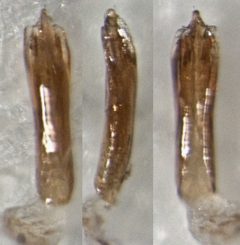
Cis boleti is a minute ciid (2.8–4 mm) with uniform brown coloration. It inhabits the fruiting bodies of polypore fungi, including Piptoporus betulinus, Trametes, and Coriolus versicolor. The is difficult to distinguish from closely related Cis species without examination of male genitalia. Its feeding activity reduces the reproductive of fungi by damaging the spore-producing hymenium.


Pronunciation
How to pronounce Cis boleti: //sɪs boʊˈleɪtaɪ//
These audio files are automatically generated. While they are not always 100% accurate, they are a good starting point.
Identification
Externally indistinguishable from many congeneric ; reliable identification depends on microscopic examination of male genitalia. Within its range, found in association with polypore fungi on wood.
Images
Appearance
Tiny , 2.8–4 mm in length. Uniformly brown in coloration. External highly similar to other Cis ; definitive identification requires examination of male genitalia.
Habitat
Inhabits fruiting bodies of bracket fungi (polypores) growing on trees. Specifically documented from Piptoporus betulinus, Trametes , and Coriolus versicolor. Associated with decaying wood and fungal substrates in forested environments.
Distribution
Europe eastward across the Palearctic to Japan. GBIF records confirm presence in Belgium and broader Europe & Northern Asia region.
Diet
Fungivorous; feeds on tissues of polypore fungi. on fruiting bodies of wood-decaying bracket fungi.
Host Associations
- Piptoporus betulinus - inhabits fruit bodies
- Trametes gibbosa - attracted to and inhabits fruit bodiesDemonstrated antennal and behavioral attraction to fungal odor volatiles
- Coriolus versicolor - inhabits fruit bodies; reduces reproductive Experimental studies show 30% reduction in reproductive potential
Behavior
Exhibits specialized attraction to fungal odor volatiles, demonstrated through electroantennography and assays. Actively seeks out and colonizes fruiting bodies of specific polypore fungi. Feeding activity concentrated on hymenial tissue of fungi.
Ecological Role
fungivore that impacts reproductive of polypore fungi through consumption of spore-producing tissues. Part of the of ciid beetles associated with wood-decaying fungi in forest .
Human Relevance
Contributes to natural decomposition processes in forest . No direct economic importance to humans; not a pest of cultivated fungi or timber products.
Similar Taxa
- Other Cis speciesMorphologically very similar; distinguished primarily by male genitalia characteristics
- Octotemnus glabriculusCo-occurs on Coriolus versicolor; causes greater reduction (58%) in fungal reproductive compared to C. boleti (30%)
More Details
Chemosensory biology
Demonstrates specific antennal detection of and behavioral attraction to volatile compounds emitted by fungus Trametes gibbosa, indicating specialized chemical communication with fungal hosts.
Fungal fitness impact
Contrary to earlier assumptions that insect has neutral effects on fungal , experimental evidence shows C. boleti feeding significantly reduces the functional area of hymenium and decreases reproductive potential.
Sources and further reading
- BugGuide
- Wikipedia
- GBIF taxonomy match
- iNaturalist taxon
- NCBI Taxonomy
- biodiversity | Blog - Part 55
- entomology | Blog - Part 17
- Diptera | Blog - Part 2
- Stylish Lepidoptera: Ermine Moth, Atteva aurea; Yellow-Collared Scape Moth, Cisseps fulvicollis; Pearl Crescent, Phyciodes tharos; Variegated Fritillary, Euptoieta claudia — Bug of the Week
- fungus gnat | Blog
- fly | Blog
- Antennal and Behavioral Responses of Cis boleti to Fungal Odor of Trametes gibbosa
- Effects of fungivory by two specialist ciid beetles (Octotemnus glabriculus and Cis boleti) on the reproductive fitness of their host fungus, Coriolus versicolor