
Mecynotarsus
LaFerté-Sénectère, 1849
monoceros beetles
Species Guides
2- Mecynotarsus candidus(monoceros beetle)
- Mecynotarsus delicatulus(monoceros beetle)
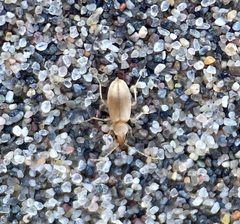
Mecynotarsus is a of anthicid beetles comprising approximately 19 described . At least one species, M. tenuipes, is specialized for life in sandy substrates and possesses a large pronotal horn used for digging and locomotion in loose sand. The genus belongs to the Anthicidae, commonly known as ant-like flower beetles or monoceros beetles.
Pronunciation
How to pronounce Mecynotarsus: //mɛˌsaɪnoʊˈtɑrsəs//
These audio files are automatically generated. While they are not always 100% accurate, they are a good starting point.
Identification
Members of this may be distinguished from other anthicid beetles by the presence of a large, prominent pronotal horn in at least some . M. tenuipes specifically exhibits this horn, which is integrated with the to form a conical digging apparatus. The absence of in horn size distinguishes it from many other horned beetles where horns function primarily in intraspecific combat.
Images
Habitat
Sandy environments; at least M. tenuipes is specialized for life in loose sand where it burrows and moves through the substrate.
Distribution
Recorded from Norway (NO) and Sweden (SE) in available distribution data.
Behavior
M. tenuipes uses its pronotal horn in a specific digging sequence: the horn and are joined to form a conical shape for piercing into sand, then opened outward to create space for forward motion. This is repeated sequentially to achieve deep burrowing. Digging speed decreases with depth, likely due to increasing substrate weight. The horn is not used for intraspecific combat, as indicated by the absence of positive allometry or in horn size.
Similar Taxa
- Stricticollis valgipesHornless anthicid that co-occurs in sandy but cannot dig into sand, unlike M. tenuipes
- Clavicollis fugiensHornless anthicid that lacks the digging capability possessed by M. tenuipes