
Leptacinus intermedius
Donisthorpe, 1936
Intermediate Rove Beetle
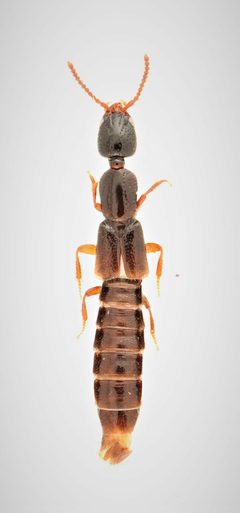
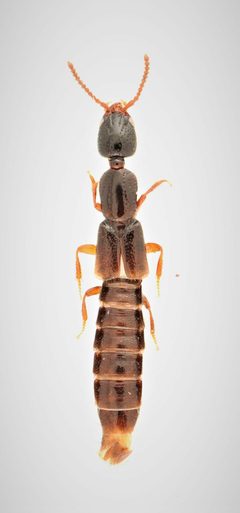
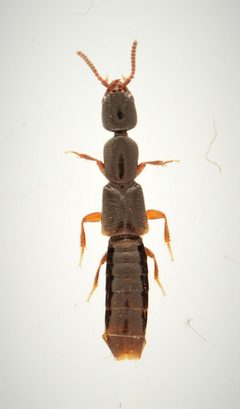
Leptacinus intermedius is a European rove beetle in the Staphylinidae, described by Horace Donisthorpe in 1936. The has been introduced to North America, where it is now established in Canada and the United States. Like other staphylinids, and larvae are predatory on other insects.
Pronunciation
How to pronounce Leptacinus intermedius: /ˌlɛp.təˈsiː.nəs ˌɪn.tərˈmɛ.di.əs/
These audio files are automatically generated. While they are not always 100% accurate, they are a good starting point.
Identification
Can be distinguished from similar rove beetles by male genitalia ( size). The short exposing multiple abdominal segments is characteristic of the Staphylinidae but not diagnostic to level.
Images
Appearance
Typical rove beetle with very short that leave three to six abdominal segments exposed. The body is elongated with the characteristic flexible of the . Males possess a distinctive that can be used for identification.
Distribution
Native to Europe (including Belarus, Ukraine, Turkey, Algeria, Libya, and the Canary Islands). Introduced and established in Canada (Alberta, British Columbia, Manitoba, New Brunswick, Newfoundland, Northwest Territories, Ontario, Prince Edward Island, Quebec, Saskatchewan) and the United States (Arizona, California, Colorado, Connecticut, Illinois, Indiana, Massachusetts, Nebraska, New Hampshire, New Mexico, Nevada, New York, Ohio, Oregon, Pennsylvania, Rhode Island, Washington).
Diet
Predatory on other insects.
Ecological Role
of other insects.
Human Relevance
Non-native in North America, established through introduction.
Similar Taxa
- Other Leptacinus speciesRequire examination of male for definitive identification.
- Other StaphylinidaeShare short and exposed abdominal segments; -level identification requires detailed morphological examination.
More Details
Taxonomic Note
The was described by Horace Donisthorpe in 1936, though some sources cite 1935.
Introduction History
The has been introduced to North America and is now widely distributed across Canada and the northern and western United States.
Sources and further reading
- BugGuide
- Wikipedia
- GBIF taxonomy match
- iNaturalist taxon
- NCBI Taxonomy
- Catalogue of Life
- Encyrtid Holdings | Entomology Research Museum
- Bembicid Holdings | Entomology Research Museum
- Captive-bred population could save endangered crocodile from extinction
- Bug Eric: The Tarantula Hunt
- 9th Annual Fall Tiger Beetle Trip: Day 1 | Beetles In The Bush
- Botanizing (again!) at Victoria Glades Conservation Area | Beetles In The Bush