
Philonthus sessor
Smetana, 1965
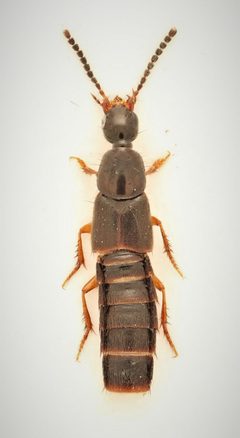
Philonthus sessor is a rove beetle in the Staphylinidae, described by Smetana in 1965. It belongs to the large and diverse Philonthus, which contains numerous predatory associated with decaying organic matter, fungi, and carrion. The species is known from northeastern North America, with records from Canada and the northeastern United States. Like other members of its genus, it likely functions as a in decomposing .
Pronunciation
How to pronounce Philonthus sessor: /fɪˈlɒnθəs ˈsɛsɔr/
These audio files are automatically generated. While they are not always 100% accurate, they are a good starting point.
Identification
Philonthus sessor can be distinguished from other Philonthus by the combination of characters in the original description by Smetana (1965). Members of the Philonthus are generally characterized by their elongate body form, shortened that leave most of the exposed, and relatively long legs adapted for rapid movement. Species-level identification within Philonthus typically requires examination of subtle morphological features including male genitalia, punctuation patterns on the pronotum and elytra, and coloration of the abdomen and appendages.
Images
Distribution
Canada (New Brunswick, Ontario, Quebec) and the northeastern United States (Iowa, Massachusetts, Maine, New Hampshire, New Jersey, New York, Pennsylvania, Vermont, Wisconsin).
Similar Taxa
- Philonthus caeruleipennisSimilar in general appearance as a rove beetle with metallic coloration, but P. caeruleipennis has distinctive blue-green and is larger (12-15 mm), whereas P. sessor has different coloration and body proportions.
- Other Philonthus speciesNumerous share the general rove beetle body plan with shortened ; definitive separation requires examination of diagnostic characters including and punctation patterns as detailed in Smetana's revisionary works.