
Philonthus carbonarius
(Gravenhorst, 1802)
Philonthus carbonarius is a rove beetle ( Staphylinidae) native to the Palearctic region, introduced to North America. It is a predatory associated with decaying organic matter, including carrion and fungi. The species was first documented in North America in the late 20th century and has since established across Canada and the United States.
Pronunciation
How to pronounce Philonthus carbonarius: //faɪˈlɒnθəs ˌkɑːbəˈnɛəriəs//
These audio files are automatically generated. While they are not always 100% accurate, they are a good starting point.
Identification
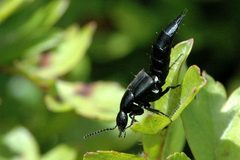
Distinguished from other Philonthus by its uniformly dark, carbon-black coloration. Separation from similar dark rove beetles requires examination of genitalia and other microscopic characters. In North America, it can be confused with native Philonthus species and other dark staphylinids in carrion and fungal . Accurate identification typically requires reference to specialized keys for the Philonthus.
Images
Habitat
Found in association with decaying organic matter including carrion, , compost, and decaying fungi. Often occurs in forested and semi-open where such resources are available.
Distribution
Native to Europe, Russia (European part, Siberia, Far East), North Africa (Algeria, Canary Islands), Caucasus region (Armenia, Georgia), Turkey, Iran, Central Asia (Kazakhstan, Kyrgyzstan, Uzbekistan), Mongolia, China (Heilongjiang), India, and Nepal. Introduced to North America, with records from Canada (British Columbia, Manitoba, New Brunswick, Newfoundland, Nova Scotia, Ontario, Prince Edward Island, Quebec, Saskatchewan, Yukon) and widespread in the United States.
Diet
Predatory. Feeds on small found in decaying organic matter, including fly larvae and other insects associated with carrion and fungi.
Behavior
A predatory rove beetle that actively hunts in decaying substrates. Like other staphylinids, it is likely capable of and may be attracted to carrion and other decomposing materials from a distance.
Ecological Role
in decomposition , helping regulate of other insects (particularly fly larvae) in carrion and fungal . Contributes to nutrient cycling through its association with decay processes.
Human Relevance
Introduced in North America; ecological impacts not well documented. May be encountered by forensic entomologists in carrion studies. Not known to be a pest or beneficial species in agricultural or urban contexts.
Similar Taxa
- Philonthus caeruleipennisSimilar size and body form, but P. caeruleipennis has distinctive metallic blue-green rather than uniform black coloration.
- Philonthus politusAnother dark rove beetle in the same found in similar ; requires microscopic examination for reliable separation.
- Other Philonthus speciesMany in this large are dark-colored and require detailed examination of genitalia and other characters for identification.
More Details
Introduction to North America
First documented in North America in Michigan and New York in 1991 (Kurczewski & O'Brien, 1991), with subsequent spread across much of Canada and the United States. The mechanism of introduction is unknown but likely associated with human commerce.
Taxonomic note
The Philonthus is large and taxonomically complex, with many requiring expert identification. P. carbonarius is one of several Palearctic species that have established in North America.