
Flohria
Sharp, 1884
Species Guides
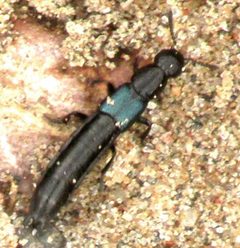
1- Flohria subcoerulea(Cerulean Rove Beetle)
Flohria is a of rove beetles (Staphylinidae) containing a single , Flohria subcoerulea. The genus was erected by David Sharp in 1884 and named in honor of collector Julius Flohr. Phylogenetic studies suggest it may occupy a basal position within the subtribe Philonthina, potentially representing a relict lineage.
Pronunciation
How to pronounce Flohria: /ˈflɔːr.i.ə/
These audio files are automatically generated. While they are not always 100% accurate, they are a good starting point.
Identification
The sole , Flohria subcoerulea, is distinguished by an unusually elongated, cylindrical body with an longer than the combined , pronotum, and . The body reaches 15.2 mm in length. The head is wider than long and narrower than the pronotum. are relatively short and thick. are prominent and stout with 2-3 teeth on the inner edges. The body is black with metallic blue elytra.
Images
Habitat
Occurs across an exceptionally broad elevational range, from tropical and subtropical forests near sea level to temperate forests on volcanic peaks up to nearly 3000 meters elevation. Recorded from natural including scrub, ranchland, and suburban gardens.
Distribution
Ranges from south-central Texas southward through Mexico to northern Rica in Central America.
Similar Taxa
- Other Philonthina generaFlohria subcoerulea differs from other subtribe members by its elongated cylindrical body form with disproportionately long , wider-than-long shape, and metallic blue against black body.
More Details
Taxonomic history
The was originally described with Flohria laticornis (1884). In 2000, Gastrisus subcoeruleus (1863) was transferred to Flohria. By 2002, Flohria laticornis was synonymized with Flohria subcoerulea, restoring the genus to monotypy. The older epithet subcoerulea was retained based on priority despite the subjective junior synonym status of laticornis.
Phylogenetic significance
As of 2015, available phylogenetic data suggested Flohria may be sister to all remaining in Philonthina, indicating a potentially basal and relict position within the subtribe.
Etymology
The honors Julius Flohr, who collected extensively in Mexico. The epithet subcoerulea derives from Latin sub (near) and caeruleus (blue), referring to the metallic blue .