
Lucifotychus testaceus
(Casey, 1884)
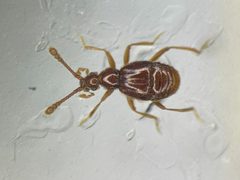
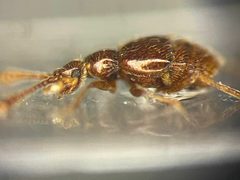
Lucifotychus testaceus is a minute rove beetle ( Staphylinidae) in the Pselaphinae, commonly referred to as an ant-loving beetle. It is a myrmecophilous associated with colonies. The species is documented from eastern and midwestern North America, with records spanning Canada and the United States.
Pronunciation
How to pronounce Lucifotychus testaceus: //ˌluːsɪˈfɒtɪkəs tɛsˈtæsiəs//
These audio files are automatically generated. While they are not always 100% accurate, they are a good starting point.
Identification
Members of Lucifotychus can be distinguished from related tychine by genitalic characters and subtle differences in antennal club structure. Within the genus, L. testaceus is recognized by its testaceous (yellowish-brown to chestnut-brown) coloration. As with most Pselaphinae, reliable identification to requires examination of male genitalia under high magnification.
Images
Habitat
Found in association with nests, particularly in forest floor and soil where ants occur.
Distribution
Eastern and midwestern North America: Canada (New Brunswick, Newfoundland, Ontario, Quebec) and USA (Connecticut, Iowa, Illinois, Indiana, Massachusetts, Maine, Michigan, Minnesota, New Hampshire, New Jersey, New York, Ohio, Pennsylvania, Rhode Island, Virginia, Wisconsin, West Virginia).
Host Associations
- Formicidae - myrmecophilousAnt-loving beetle; specific not documented
Behavior
Myrmecophilous; lives in association with colonies, though specific behavioral adaptations remain undocumented.
Ecological Role
Likely functions as a commensal or within nests; ecological role not well studied.
Similar Taxa
- Other Lucifotychus species-level similarity in body form and myrmecophilous habit; distinguished by coloration and male genitalia
- Other Tychini generaSimilar small size, antennal club structure, and -associated ; require genitalic examination for separation