
Euplectus karstenii
(Reichenbach, 1816)
Euplectus karstenii is a minute rove beetle in the Pselaphinae, characterized by its compact body form and reduced typical of ant-loving beetles. The has a broad native distribution across the Palearctic region and has been introduced to North America, Australia, and potentially South America through human activity. As a member of the myrmecophilous Pselaphinae, it is associated with colonies, though specific relationships remain poorly documented.
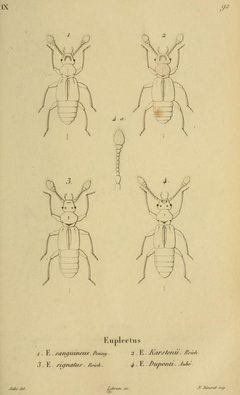
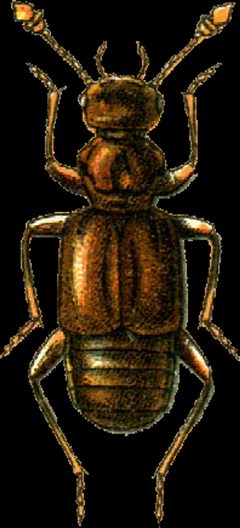
Pronunciation
How to pronounce Euplectus karstenii: //juːˈplɛk.təs ˈkar.sten.i.aɪ//
These audio files are automatically generated. While they are not always 100% accurate, they are a good starting point.
Identification
Distinguishable from other Euplectus by the combination of: pronotal foveae structure, elytral setation patterns, and male genitalia (paramere shape). Requires microscopic examination; separation from E. punctatus and E. sanguineus depends on detailed examination of antennal club segments and metaventral process structure. Specimens are minute (approximately 1.5–2.0 mm), with the characteristic pselaphine body plan: short exposing most of the , compact form, and clubbed .
Images
Habitat
Found in forest floor litter, particularly in deciduous and mixed woodlands with established . Occupies microhabitats within ant nest refuse piles, soil cavities, and decaying wood associated with Formicidae colonies. Introduced populations in North America occur in similar mesic forest environments.
Distribution
Native range: Europe (widespread), European Russia, Siberia, Russian Far East, Turkey, Algeria, Canary Islands, Madeira, and Iran. Introduced to: Canada (British Columbia, Manitoba, New Brunswick, Ontario, Prince Edward Island, Quebec, Saskatchewan), USA (District of Columbia, Iowa, Illinois, Massachusetts, Maine, Michigan, Minnesota, Montana, New Hampshire, New York, Pennsylvania, Wisconsin), Australia, and possibly Chile.
Host Associations
- Formicidae - myrmecophilyGeneral association with colonies; specific not documented
Behavior
Exhibits myrmecophilous , living in close association with colonies. The compact, heavily sclerotized body form is an for moving within ant nest environments. Specific behavioral interactions with ants (such as chemical mimicry or ) have not been documented for this .
Ecological Role
Functions as a myrmecophilous in colonies, likely feeding on organic detritus, fungal , or ant regurgitations within the nest microhabitat. Contributes to nutrient cycling in forest floor through its association with ant .
Human Relevance
Accidentally introduced to North America, Australia, and potentially South America through human commerce, likely via soil and plant material transport. Not considered economically significant. Serves as an indicator of human-mediated in studies.
Similar Taxa
- Euplectus punctatusOverlapping distribution in Europe; distinguished by differences in pronotal foveae arrangement and male genitalia paramere structure
- Euplectus sanguineusSimilar size and general habitus; separation requires examination of antennal club segment proportions and coloration of appendages
- Pselaphinae (general)All members share reduced and myrmecophilous tendencies; Euplectus karstenii is distinguished by -level characters including tarsal formula and foveal patterns
More Details
Taxonomic History
Originally described as Pselaphus karstenii by Reichenbach in 1816, later transferred to the Euplectus. The has been subject to repeated introductions globally, making it one of the more widely distributed Pselaphinae species.
Conservation Status
Not evaluated by IUCN. Widespread distribution and introduced range suggest stable status.