
Euplectini
Streubel, 1839
Genus Guides
3- Euplectus(ant-loving beetles)
- Leptoplectus
- Pycnoplectus
Euplectini is a tribe of minute rove beetles within the Pselaphinae (Staphylinidae). Members are characterized by their small body size, often under 3 mm, and complex antennal structures. The tribe was established by Streubel in 1839 and contains numerous distributed across multiple continents. These beetles are primarily found in leaf litter and soil where they function as micro- or fungivores.
Pronunciation
How to pronounce Euplectini: /juːˈplɛktɪnaɪ/
These audio files are automatically generated. While they are not always 100% accurate, they are a good starting point.
Identification
Distinguished from other Pselaphinae tribes by the combination of: small size (<3 mm), antennal club with enlarged terminal segments (often with male asymmetry), and the presence of characteristic foveae (pits) or (ridges) on the pronotum and . The tribe Euplectini is separated from closely related tribes such as Trogastrini and Jubini primarily by antennal structure and the detailed configuration of the pronotal and elytral foveal patterns. Genitalia examination is often required for definitive identification.
Images
Appearance
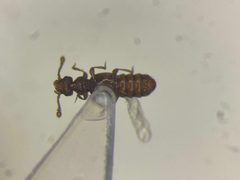
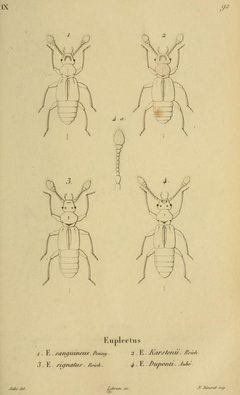
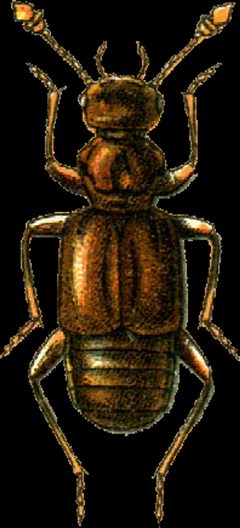
Extremely small beetles, usually 1–3 mm in length. Body compact and often somewhat humpbacked in profile. typically with a distinct club of 2–3 enlarged terminal segments (capitulum), sometimes with asymmetrical clubs in males. short, exposing most of the . often with reduced segmentation (3-3-3 or similar formula). Many exhibit in antennae and pronotal structure.
Habitat
Predominantly found in moist terrestrial microhabitats: leaf litter, decaying wood, moss, soil humus, and nests. Some inhabit caves or intertidal zones. Strong association with complex, stable microenvironments with high humidity and organic matter accumulation.
Distribution
distribution with highest diversity in tropical and subtropical regions. Well-represented in the Palearctic, Oriental, and Neotropical regions. Present but less diverse in the Nearctic, Afrotropical, and Australasian regions.
Seasonality
Activity patterns vary by latitude. In temperate regions, are most commonly encountered in spring through autumn; in tropical regions, activity appears more continuous. Many show reduced surface activity during dry or cold periods, persisting in deeper soil or litter layers.
Life Cycle
Complete with , larva, pupa, and stages. Larvae are poorly known for most but are presumed to inhabit the same microhabitats as adults. Developmental timing is undocumented for the vast majority of species.
Behavior
Ecological Role
Function as micro- on small (springtails, mites, ) and/or fungivores within decomposer . Contribute to nutrient cycling in forest floor and soil . Some may serve as indicators of stability and microclimate conditions.
Human Relevance
No direct economic importance. Occasionally collected by entomologists for biodiversity surveys and ecological research. Some are used as indicators in conservation assessments of forest litter .
Similar Taxa
- TrogastriniAnother tribe of Pselaphinae with similar body form; distinguished by antennal structure (usually with more symmetrical clubs) and different configuration of pronotal foveae.
- JubiniClosely related tribe with similar size and preferences; separated by details of antennal segmentation and the presence or absence of particular elytral setal patterns.
- PselaphiniNominate tribe of the ; members often have more elongated body form and different antennal club structure.
More Details
Taxonomic History
The tribal classification of Pselaphinae has undergone substantial revision. Euplectini as currently circumscribed may not be monophyletic, and molecular phylogenetic studies are ongoing to clarify relationships within the .
Collection Methods
Best collected by sifting leaf litter and extracting with , or by hand-sorting decaying wood and moss. Pitfall traps are generally ineffective due to the small size and non-vagile nature of these beetles.