
Arthmius bulbifer
Casey, 1893
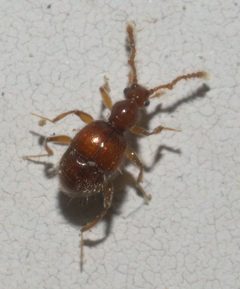
Arthmius bulbifer is a of ant-loving beetle in the rove beetle Staphylinidae, described by Thomas L. Casey in 1893. The species belongs to the Pselaphinae, a group of small beetles commonly associated with colonies. It is known from scattered records across the south-central United States.
Pronunciation
How to pronounce Arthmius bulbifer: //ˈɑɹθ.mi.əs ˈbʌl.bɪ.fər//
These audio files are automatically generated. While they are not always 100% accurate, they are a good starting point.
Images
Habitat
Mesic and dry-mesic deciduous upland forests, particularly in areas with rocky substrates such as dolomite bluffs. Associated with forested that support diverse fern and complex ground-layer vegetation.
Distribution
North America. Documented from the south-central United States including Arkansas, Texas, Oklahoma, and Kansas.
Behavior
As a member of the Pselaphinae, it has been observed in association with colonies ('ant-loving beetle'), though specific behavioral details for this are not documented.
Ecological Role
Member of the forest floor ; likely contributes to nutrient cycling through decomposition processes and serves as prey for larger arthropods and small vertebrates.
More Details
Taxonomic context
The Arthmius belongs to the tribe Batrisini within the diverse Pselaphinae. Pselaphine beetles are among the most -rich groups of rove beetles, with many species showing specialized ecological associations.
Etymology
The specific epithet 'bulbifer' derives from Latin, meaning 'bulb-bearing', though the anatomical reference is not specified in the original description.