
Proteinus collaris
Hatch, 1957
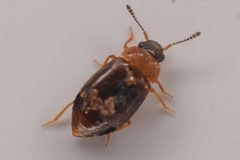
Proteinus collaris is a small rove beetle in the Staphylinidae, described by Hatch in 1957. It belongs to the Proteininae, a group of beetles often associated with fungal . The is known from the Pacific Northwest region of North America, with records from coastal British Columbia, Washington, and Alaska. Like other members of the Proteinus, it is likely associated with decaying organic matter and fungal fruiting bodies.
Pronunciation
How to pronounce Proteinus collaris: /pɹoʊˈtiːnəs kəˈlɛərɪs/
These audio files are automatically generated. While they are not always 100% accurate, they are a good starting point.
Identification
Proteinus collaris can be distinguished from other Proteinus by the presence of a distinct collar-like structure on the pronotum, as suggested by its specific epithet. Members of the Proteinus are small rove beetles (typically 2–4 mm) with compact bodies, short that leave most of the exposed, and with a distinct club. The species can be separated from the more widespread P. brachypterus by differences in pronotal shape and the structure of the abdominal tergites. Accurate identification typically requires examination of male genitalia.
Images
Habitat
Based on -level associations and regional patterns, P. collaris likely inhabits moist forest environments where it occurs in decaying wood, leaf litter, and particularly in association with fungal fruiting bodies. The Pacific Northwest distribution suggests a preference for temperate coastal rainforest conditions with high humidity and abundant decaying organic matter.
Distribution
Pacific Northwest of North America: recorded from British Columbia (Canada), Washington and Alaska (USA). The distribution appears restricted to coastal and near-coastal regions of the northern Pacific seaboard.
Ecological Role
As a member of the Proteininae, P. collaris likely functions as a decomposer in forest , contributing to nutrient cycling through its association with decaying organic matter and fungi. The Proteinus is known to include that prey on fungal spores and small in decaying substrates.
Similar Taxa
- Proteinus brachypterusOverlapping geographic range in Pacific Northwest; differs in pronotal structure and abdominal tergite ; generally more widespread
- Proteinus ovalisSimilar small size and preferences; distinguished by body shape and male genitalia structure