
Megarthrus
Stephens, 1829
Species Guides
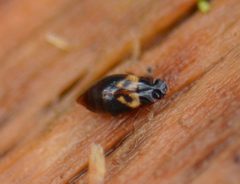
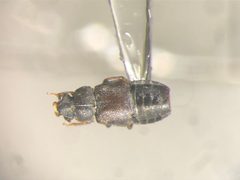
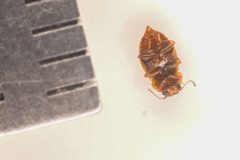
3Megarthrus is a of rove beetles (Staphylinidae: Proteininae) comprising approximately 140 described , making it the largest genus in its . The genus exhibits a worldwide amphipolar distribution, with greater diversity in the Holarctic region. In tropical zones, species are largely restricted to mountain , resulting in high levels of . Species are typically small and inhabit forest floor environments, with some lineages showing distinctive morphological specializations.
Pronunciation
How to pronounce Megarthrus: //mɛˈɡɑrθrəs//
These audio files are automatically generated. While they are not always 100% accurate, they are a good starting point.
Identification
Megarthrus are distinguished from other Proteininae by features of the male genitalia and abdominal sternites, which form the basis for species-group classifications. The is characterized by distinctive body proportions and antennal structure, though specific diagnostic traits vary among (e.g., M. hemipterus complex, M. calcaratus complex, M. inaequalis-supergroup). Identification to species level requires examination of male abdominal sternite VIII and .
Images
Habitat
Forest floor environments; in tropical regions, are restricted to mountain areas including cloud forests and temperate forests at elevation. Holarctic species occupy broader forested .
Distribution
Worldwide with amphipolar distribution pattern; most diverse in Holarctic region. Documented from North America, Europe, Asia (including China, Korea, Japan, Russian Far East), Mexico, Central America, South America, Africa, and Papua New Guinea. show high regional , particularly in tropical mountains.
Behavior
A 'water loading' has been observed in which beetles load water onto the dorsum using complex morphological structures; this behavior has been documented in M. auricola and subsequently observed in other Proteininae and Omaliinae .
More Details
Species diversity
The contains approximately 140 described , with ongoing taxonomic work revealing substantial undescribed diversity, particularly in tropical mountain regions.
Biogeographic significance
The tropical mountain restriction and high make Megarthrus a potentially informative for biogeographic analysis, as noted in studies of Central and South American, Chinese, and Korean faunas.
Sources and further reading
- BugGuide
- Wikipedia
- GBIF taxonomy match
- iNaturalist taxon
- NCBI Taxonomy
- Catalogue of Life
- A new Mexican species of Megarthrus Curtis (Coleoptera, Staphylinidae, Proteininae)
- Two new species of Megarthrus (Coleoptera, Staphylinidae, Proteininae) from Mexican Cloud Forests
- Megarthrusof Korea, with description of a new species (Coleoptera: Staphylinidae: Proteininae)
- Megarthrus of China. Part 5. The M. calcaratus complex, with description of three new species (Coleoptera: Staphylinidae: Proteininae)
- Two new species of Megarthrus (Coleoptera, Staphylinidae, Proteininae) and a note on ‘water loading’ behaviour
- Megarthrus of China. Part 4. The M. hemipterus complex (Coleoptera, Staphylinidae, Proteininae), with description of a new species from Yunnan Province