
Rugilus angustatus
(Geoffroy, 1785)
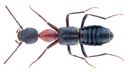
Rugilus angustatus is a rove beetle (Staphylinidae) native to Europe and western Asia, with established introduced in eastern North America. It is a moderately sized within the diverse Rugilus, characterized by its elongate body form typical of the . The species has been documented across a broad Palearctic range and has been observed in North American localities since at least the mid-20th century.
Pronunciation
How to pronounce Rugilus angustatus: //ˈruːɡɪləs ˌæŋɡʊˈstɑːtəs//
These audio files are automatically generated. While they are not always 100% accurate, they are a good starting point.
Identification
Distinguished from other Rugilus by the combination of: body size and proportions; male genitalia with specific lobe (examination required for definitive identification); and distribution pattern. Separated from similar Staphylinini by the structure of the and details of the abdominal tergite chaetotaxy. In North America, most likely confused with other introduced or native Staphylininae; requires dissection of male specimens for reliable determination.
Images
Habitat
Found in moist, decaying organic matter including leaf litter, compost, and decaying vegetation. Often associated with riparian zones, floodplain forests, and disturbed with abundant organic debris. In North America, has been collected in urban and suburban settings including gardens and parks.
Distribution
Native to Europe from the British Isles and Scandinavia south to the Mediterranean, and east through Russia to western Siberia, the Caucasus (Armenia, Georgia), Turkey, Cyprus, Lebanon, and Iran. Introduced and established in eastern North America: Canada (New Brunswick, Nova Scotia, Ontario, Quebec) and USA (Massachusetts, Maine, Nebraska, New Hampshire, New York).
Seasonality
active primarily in spring through autumn; peak activity varies by latitude. In temperate regions, most frequently collected from April to October.
Ecological Role
or scavenger in decaying organic matter; specific ecological functions not well documented.
Human Relevance
Non-pest ; occasionally collected in urban and agricultural settings. No documented economic importance.
Similar Taxa
- Rugilus rufipesSimilar size and general appearance; distinguished by leg coloration (more distinctly in R. rufipes) and male genitalia structure.
- Other Staphylinini genera (e.g., Quedius, Staphylinus)Similar body plan and use; require examination of and abdominal chaetotaxy for separation.
More Details
Taxonomic History
Originally described by Geoffroy in 1785 as Staphylinus angustatus; transferred to Rugilus by later authors. The Rugilus was historically treated as a subgenus of Staphylinus but is now recognized as distinct.
Introduction to North America
First documented in North America in the mid-20th century; established now known from multiple localities in northeastern North America. Likely introduced via human commerce in organic materials.