
Lesteva pallipes
LeConte, 1863
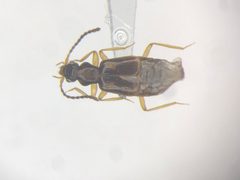
Lesteva pallipes is a of rove beetle (Staphylinidae) first described by J.L. LeConte in 1863. Research indicates this species may be a of the subnivium—the air pocket beneath winter snowpack—where it remains active during winter months and is rare or inactive during summer. This apparent seasonal specialization makes it potentially vulnerable to climate change impacts on snowpack persistence.
Pronunciation
How to pronounce Lesteva pallipes: /lɛsˈtɛva ˈpælɪˌpɛz/
These audio files are automatically generated. While they are not always 100% accurate, they are a good starting point.
Images
Habitat
Has been observed in the subnivium, the air space between soil surface and snowpack in forested areas with winter snow cover. The subnivium forms where ground warmth causes snow sublimation, creating a stable, insulated microhabitat.
Distribution
North America: Canada (New Brunswick, Newfoundland, Nova Scotia, Ontario, Quebec) and USA (Alabama, Arkansas, District of Columbia, Georgia, Iowa, Illinois, Indiana, Kentucky, Massachusetts, Maryland, Maine, Missouri, New Hampshire, New York, Ohio, Pennsylvania, Rhode Island, Tennessee, Virginia).
Seasonality
Winter-active in the subnivium; rare or inactive during summer months. This reversed seasonality distinguishes it from most ground-dwelling beetles.
Behavior
Appears to be a subnivium , potentially active exclusively during winter beneath snowpack. May undergo dormancy during summer months when surface conditions are favorable for most ground-dwelling arthropods.
Ecological Role
within subnivium . The subnivium includes other predators such as spiders and , with reduced competition compared to summer surface communities.
More Details
Climate Vulnerability
Identified as one of four (along with the spider Cicurina brevis and rove beetles Arpedium cribratum and Porrhodites inflatus) that dominate the subnivium and appear specialized to this . Declining snowpack due to climate change threatens these species with exposure to temperature extremes and potential local extirpation.
Sources and further reading
- BugGuide
- GBIF taxonomy match
- iNaturalist taxon
- NCBI Taxonomy
- Catalogue of Life
- The Day That Dragonflies Sprang to Life | Bug Squad
- Secrets of the "Subnivium": Arthropod Community Thrives Beneath Winter Snowpack
- A step back for species-rich grasslands: why removing them from the Sustainable Farming Initiative matters for our endangered invertebrates - Buglife Blog - Buglife
- Conservation Translocations: It’s Not Just Beavers - Buglife Blog - Buglife
- In Search of Britain’s Endemics - Buglife Blog - Buglife