
Hoplandriini
Casey, 1910
Hoplandriini rove beetles
Tribe Guides
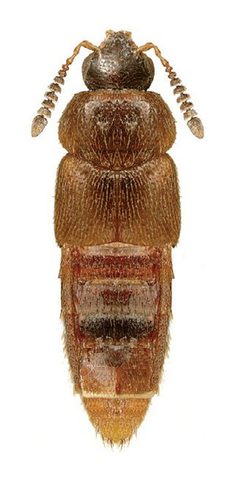
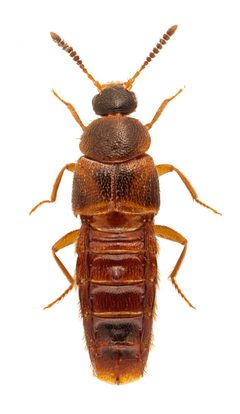
3Hoplandriini is a tribe of small rove beetles (Staphylinidae: Aleocharinae) containing at least 5 and 21 described . The tribe includes the genus Microlia, whose members are pollen-feeders frequently associated with flowers of Cucurbitaceae, Solanaceae, Asteraceae, and Monimiaceae. Some species, such as Microlia cayaponia, have been observed foraging on Cayaponia flowers and may compete with for pollen resources. The tribe occurs in the New World and Australasia.
Pronunciation
How to pronounce Hoplandriini: /hɔp.lænˈdri.aɪ.naɪ/
These audio files are automatically generated. While they are not always 100% accurate, they are a good starting point.
Identification
Members of Hoplandriini can be distinguished from other Aleocharinae tribes by tribal-level morphological characters; -level identification requires examination of specific diagnostic features. The genus Microlia is characterized by small body size and association with flowers, though this ecological trait alone is insufficient for definitive identification.
Images
Habitat
Flower , particularly those of Cucurbitaceae, Solanaceae, Asteraceae, and Monimiaceae. Specific records document association with Cayaponia (Cucurbitaceae) flowers in Brazil.
Distribution
New World and Australasia; documented occurrences include Brazil.
Diet
Pollen-feeding has been documented in Microlia .
Host Associations
- Cayaponia - flower associationCucurbitaceae; of Microlia cayaponia
- Cucurbitaceae - flower association-level association for Microlia
- Solanaceae - flower association-level association for Microlia
- Asteraceae - flower association-level association for Microlia
- Monimiaceae - flower association-level association for Microlia
Behavior
Flower visitation and pollen foraging. Microlia cayaponia has been observed exhibiting that may impact plant and through competition for pollen resources.
Ecological Role
Flower visitor; potential competitor to for pollen resources; may influence pollination dynamics through resource competition.
Similar Taxa
- Other Aleocharinae tribesShare characteristics but differ in tribal-level morphological features and, in the case of Microlia, distinctive flower-associated
More Details
Taxonomic composition
The tribe comprises five : Hoplandria (Kraatz, 1857), Microlia (Casey, 1910), Platandria (Casey, 1893), Pseudoplandria (Fenyes, 1921), and Tetrallus (Bernhauer, 1905).