
Gyrophaena meduxnekeagensis
Klimaszewski & Webster, 2009
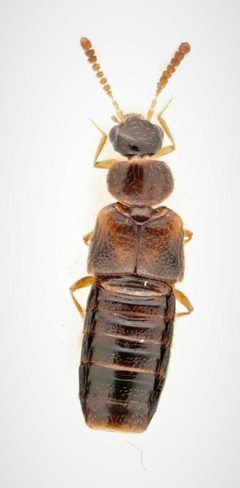
Gyrophaena meduxnekeagensis is a small rove beetle (Staphylinidae: Aleocharinae) described from eastern Canada in 2009. As a member of the Gyrophaena, it is associated with fungal , particularly polypore bracket fungi. The is currently known from a limited number of records in New Brunswick, Ontario, and Quebec.
Pronunciation
How to pronounce Gyrophaena meduxnekeagensis: //dʒaɪroʊˈfiːnə mɪˌdʌksnəˌkiːəˈdʒɛnsɪs//
These audio files are automatically generated. While they are not always 100% accurate, they are a good starting point.
Identification
Distinguished from other Gyrophaena by subtle morphological features of the and spermatheca as detailed in the original description. Small-bodied (approximately 2–3 mm), with the compact, rounded form characteristic of the . Accurate identification requires examination of genitalic structures under magnification.
Images
Habitat
Associated with polypore fungi (bracket fungi) on decaying wood, the typical microhabitat for Gyrophaena . Specific fungus records for this species have not been published.
Distribution
Recorded from New Brunswick, Ontario, and Quebec, Canada. The type locality is in New Brunswick.
Host Associations
- Polypore fungi - Inferred from -level ; specific associations unconfirmed for this
Ecological Role
Member of the fungal in decaying wood; likely contributes to nutrient cycling through association with wood-decay fungi.
Similar Taxa
- Gyrophaena affinisOverlapping distribution in eastern Canada; distinguished by male genitalia structure
- Gyrophaena nanaSimilar size and preference; requires genitalic examination for separation
More Details
Etymology
The specific epithet meduxnekeagensis refers to the Meduxnekeag River watershed in New Brunswick, near the type locality.
Taxonomic history
Described by Klimaszewski & Webster in 2009 as part of ongoing revisionary work on North American Gyrophaena. The is known from very few specimens.