
Eumicrota socia
(Erichson, 1839)
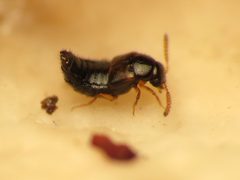
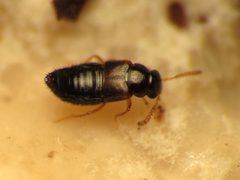
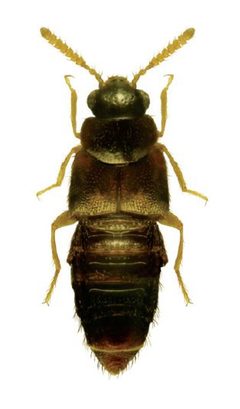
Eumicrota socia is a of rove beetle in the Staphylinidae, first described by Erichson in 1839. It belongs to the Aleocharinae and tribe Homalotini. The species is known from scattered records across eastern North America. Like other members of its , it is presumed to be associated with fungi, though specific ecological details remain poorly documented.
Pronunciation
How to pronounce Eumicrota socia: /juːˈmɪkroʊtə ˈsoʊsɪə/
These audio files are automatically generated. While they are not always 100% accurate, they are a good starting point.
Images
Distribution
Eastern North America. Documented from Canada (New Brunswick, Nova Scotia, Ontario, Prince Edward Island, Quebec) and the United States (Arkansas, District of Columbia, Florida, Illinois, Indiana, Kansas, Kentucky, Louisiana, Massachusetts, Maryland, Maine, Michigan, Missouri, North Carolina, New York, Ohio, Pennsylvania, South Carolina, Tennessee, Texas, Virginia, Wisconsin, West Virginia).
More Details
Taxonomic placement
Eumicrota socia is placed in the subtribe Gyrophaenina within the tribe Homalotini, a group of small aleocharine rove beetles often associated with fungal fruiting bodies. The specific epithet 'socia' (Latin for 'companion' or 'ally') may reflect an early observation of gregarious , though this has not been confirmed in modern studies.
Sources and further reading
- BugGuide
- GBIF taxonomy match
- iNaturalist taxon
- Catalogue of Life
- Rob Page: Honey Bees' Social Behavior Rivals Our Own | Bug Squad
- Bohart Museum Open House: Get Acquainted with Social Wasps | Bug Squad
- Social Wasps Are Great Artists and Architects, But So Are.... | Bug Squad
- Research Begins to Unravel Why Some Spiders are Social
- Social Psychological Bulletin | Blog
- Reaching Beyond Our Horizons: Combining Insects With Enthusiasm on Social Media