
Aleochara curtula
(Goeze, 1777)
Shortened Minute Rove Beetle
Aleochara curtula is a small rove beetle in the Staphylinidae, distributed across the Palearctic region and introduced to North America. measure approximately 7 mm in length with distinctive two-toned and brush-like . The exhibits complex sexual including male-male aggression, female mimicry through production, and active female mate choice. Larvae are ectoparasitoids of fly pupae, developing within carrion .
Pronunciation
How to pronounce Aleochara curtula: //ˌæliːoʊˈkærə ˈkɜːrtjʊlə//
These audio files are automatically generated. While they are not always 100% accurate, they are a good starting point.
Identification
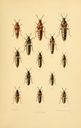
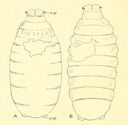
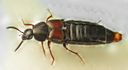
are approximately 7 mm long with a compact body form. Coloration ranges from black to brown with distinctly two-colored . are of moderate size, approximately half the length of the . bear characteristic brush-like ( or setose) sections. The shortened elytra expose most of the , typical of the Staphylinidae .
Images
Habitat
Associated with carrion and fly-infested , particularly animal carcasses of small mammals such as rodents, squirrels, and rabbits. and larvae occur on fresh carcasses that support of other insects. Warm conditions favor activity and prey attraction.
Distribution
Native to the Palearctic region: Europe, northern Asia (excluding China), Turkey, Armenia, Kazakhstan, Russia (Far East), Japan, Korea, and Mongolia. Also recorded from China and Sumatra. Introduced to North America: Canada (British Columbia, New Brunswick, Newfoundland, Nova Scotia, Ontario, Prince Edward Island, Quebec) and widespread in the United States. Introduced also reported in South Africa. Neotropical records (Brazil, Colombia, French Guiana, Peru, Bolivia, Chile, Grenada) are unconfirmed and considered questionable.
Diet
do not consume carrion directly; larvae are ectoparasitoids of dipteran pupae and other carrion-associated insect larvae.
Life Cycle
are laid in carcasses already colonized by other insect larvae. Larvae seek out and parasitize the pupal stages of flies and other carrion insects, tracking using volatiles and waste cues. Larvae must consume a host pupa to complete their own ; individuals that fail to locate hosts cannot develop. body size is determined by larval success in securing large host pupae. Sibling competition occurs among larvae sharing a carcass.
Behavior
Males are territorial and aggressive toward other males at carcass feeding and mating sites. Some males employ female mimicry by producing excess female , allowing them to avoid aggression and enter territories of rival males. Females also produce male-typical profiles to reduce harassment and control mating timing. Both sexes are strongly influenced by pheromone cues when assessing conspecifics. Males with high female pheromone levels experience reduced mating success. Females exhibit active mate choice, preferring males with low female pheromone levels that indicate superior condition. Males guard mates and aggressively exclude them from carcasses to prevent remating. Copulations are prolonged and involve transfer.
Ecological Role
Larval ectoparasitoid of carrion-associated flies, regulating of carrion insects. contribute to carrion dynamics through on larvae and competition for resources.
Human Relevance
Subject of extensive behavioral research due to its complex mating system involving sexual deception, alternative mating tactics, and sperm competition. No significant economic or medical importance reported.
Similar Taxa
- Aleochara (Aleochara) lata Gravenhorst, 1802Sympatric Palearctic in the same subgenus; distinguished by body proportions, genitalia, and subtle differences in antennal structure requiring microscopic examination.
- Aleochara (Aleochara) postica Walker, 1858Overlapping distribution in some regions; separated by differences in male and female genitalia and subtle coloration patterns.
- Aleochara (Aleochara) parens Sharp, 1874Similar size and general habitus; requires examination of spermathecal and structure for definitive identification.
Sources and further reading
- BugGuide
- Wikipedia
- GBIF taxonomy match
- iNaturalist taxon
- NCBI Taxonomy
- Meloidae Holdings | Entomology Research Museum
- Male Aggression, Female Mimicry and Female Choice in the Rove Beetle, Aleochara curtula (Coleoptera, Staphylinidae)
- Revision of Brazilian species of Aleochara Gravenhorst of the subgenus Aleochara (Coleoptera: Staphylinidae: Aleocharinae)
- Revision of the subgenus Aleochara Gravenhorst of the parasitoid rove beetle genus Aleochara Gravenhorst of Japan (Coleoptera: Staphylinidae: Aleocharinae)