
Platypsyllus
Ritsema, 1869
beaver beetle
Species Guides
1- Platypsyllus castoris(Beaver beetle)
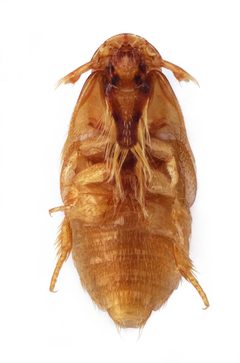
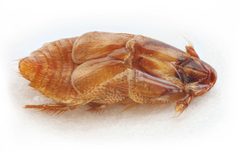
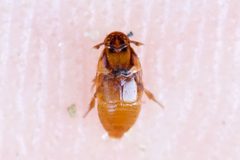
Platypsyllus is a of beetles in the Leiodidae, Platypsyllinae. The sole , P. castoris, is a highly specialized commensal associated exclusively with beavers. It exhibits extreme morphological adaptations including dorsoventral flattening, eyelessness, flightlessness, and modified mouthparts forming a sucking pump—features that distinguish it from all other beetles and reflect its unique lifestyle in the dense fur of its .
Pronunciation
How to pronounce Platypsyllus: //plætɪˈsɪləs//
These audio files are automatically generated. While they are not always 100% accurate, they are a good starting point.
Identification
Distinguished from all other beetles by its extreme dorsoventral flattening, eyeless condition, and -like appearance. Within Leiodidae, placement in Platypsyllinae indicated by these specialized features. The only , P. castoris, is further identified by its exclusive association with beavers. Resembles fleas in general form but differs in being a (hardened forewings present, though reduced) and in specific structural details of and mouthparts.
Images
Habitat
Found exclusively in association with beavers (Castor spp.), specifically within the dense fur of the , particularly in the perianal region near castor glands, wounds, and skin. is effectively the microenvironment of the host animal's pelage.
Distribution
Distribution corresponds to that of its , beavers (Castor canadensis in North America, C. fiber in Eurasia). Present where beaver occur.
Diet
Feeds on dead skin, secretions from castor glands (source of natural and raspberry flavorings), and occasionally blood or fluids from oozing wounds. Consumes liquid, possibly with emulgated minute skin debris; of mouthparts excludes damage to skin.
Host Associations
- Castor - commensalExclusive ; found in perianal region, near castor glands, wounds, and skin. Also reported from otters.
Behavior
Moves sideways through dense beaver fur using legs; posteriorly directed setae and ctenidia prevent backward displacement by hairs. Maintains position through mechanical stabilization and firm anchorage on host.
Ecological Role
Commensal; helps keep beavers clean by removing dead skin and gland secretions. Not parasitic as mouthpart prevents tissue damage.
Human Relevance
Subject of scientific interest due to extreme morphological specialization and unique commensal lifestyle. Featured in museum displays (e.g., Bohart Museum) as an example of unusual insect adaptations. Castor gland secretions consumed by beetles are commercially important as natural flavorings.
Similar Taxa
- LeptinusAlso in Platypsyllinae, associated with mammals (rodents, rabbits), but less specialized; retains more typical .
- Fleas (Siphonaptera)Convergent resemblance in dorsoventral flattening and eyelessness, but fleas are laterally compressed, have different mouthpart structure, and belong to a separate insect order.
Misconceptions
Often misidentified or misunderstood as a ; however, its mouthpart prevents skin damage, making the relationship commensal rather than parasitic. Also sometimes mistaken for a due to convergent morphology.
More Details
Morphological Specializations
The Platypsyllinae exhibits a suite of features correlated with mammal association: flattened body, cephalic shield, flightlessness, reduction, and depigmentation. Within this group, Platypsyllus displays numerous autapomorphic features specifically adapted to the beaver , including reinforced skeletal structures, modified , reduced , enhanced sucking pump musculature, and specialized leg setation for fur movement.
Taxonomic History
Formerly placed in its own Leptinidae, now classified in Leiodidae, Platypsyllinae.
Sources and further reading
- BugGuide
- iNaturalist taxon
- NCBI Taxonomy
- Catalogue of Life
- You Won't Believe What You'll See at the Bohart Museum on Picnic Day | Bug Squad
- Bohart Museum Picnic Day: Bugging Out | Bug Squad
- Who Invited Bugs to the UC Davis Picnic Day? | Bug Squad
- Just Buggin' You at UC Davis PIcnic Day | Bug Squad
- Gyrinidae | Beetles In The Bush
- June | 2010 | Beetles In The Bush | Page 2
- A unique case of commensalism: The beaver beetle Platypsyllus castoris (Leiodidae, Coleoptera) and its morphological adaptations