
Gelae
Miller, K. B. & Q. D. Wheeler, 2005
round fungus beetles
Species Guides
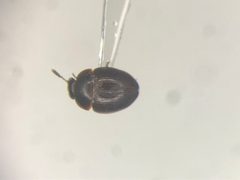
1Gelae is a of round fungus beetles in the Leiodidae, established in 2004 to accommodate previously placed in Agathidium. The genus contains eight species distributed across Central and North America, ranging from Canada to Panama. Species are small, dome-shaped beetles that feed on slime moulds. The genus name derives from Latin gelatus ("congealed" or "jellied"), referencing both their and pronunciation like "jelly". Five species described in 2004 received whimsical names based on wordplay: G. baen, G. belae, G. donut, G. fish, and G. rol.
Pronunciation
How to pronounce Gelae: /ˈɡiːlaɪ/
These audio files are automatically generated. While they are not always 100% accurate, they are a good starting point.
Identification
Distinguished from other round fungus beetles by the combination of: exactly 11 antennomeres with antennomere VII similar to VI, and a 3-segmented club; absence of postocular temporum and supraocular carina; extended ; and elytral punctures not forming longitudinal series. Most similar to the Liodopria, with which it shares a sister-group relationship, but differs in the above antennal and cephalic characters. -level identification requires examination of male genitalia and subtle differences in body size, coloration, and shape.
Images
Habitat
Found in association with slime moulds, which serve as their food source. include forested areas in mountainous regions and lake shores. Specific collection localities include: coniferous forests (Sugar Pine, California), highland cloud forests (Cerro Carpish, Peru; mountains of Totonicapán, Guatemala), oak-pine forests (Oaxaca, Mexico), riparian areas near lakes (Lake Superior, Michigan), and mountain streams (Workman Creek, Arizona).
Distribution
North and Central America. Range extends from Canada and the United States (California, Arizona, Michigan) through Mexico and Central America (Guatemala, Honduras, Rica, Panama) to South America (Peru, Bolivia). Individual have restricted ranges: G. rol is to southern Arizona mountains; G. donut to highlands of Peru and Bolivia; G. baen known only from Oaxaca, Mexico; G. fish from southern Mexico, Panama, and Central America; G. belae from Oaxaca, Mexico; G. cognatum from Mexico to Panama; G. parvulum from Lake Superior and California; and G. parile across the United States and Canada.
Diet
Slime moulds (Myxomycetes).
Behavior
are found on or near slime mould fruiting bodies, on which they feed. Specific behavioral observations beyond feeding are not documented.
Ecological Role
Consumers of slime moulds; their ecological role in nutrient cycling or dynamics has not been studied.
Human Relevance
No direct economic or medical significance. The received attention for its whimsical names (G. baen, G. belae, G. donut, G. fish, G. rol) chosen by the describing authors as "wordplays without any taxonomical jargon." The naming approach was noted in popular science coverage as an example of humor in scientific .
Similar Taxa
- AgathidiumHistorically confused with Gelae; G. cognatum, G. parvulum, and G. parile were originally described in Agathidium. Gelae differs in antennal structure (11 antennomeres with specific segment proportions, 3-segmented club), absence of postocular temporum and supraocular carina, and extended .
- LiodopriaSister within tribe Anisotomini; shares general body form and slime mould feeding habit. Gelae differs in the diagnostic antennal and cephalic characters used to define the genus.
More Details
Etymology
The name derives from Latin gelatus ("congealed" or "jellied"), pronounced like English "jelly". This references both the slime mould and the whimsical epithets. The five species described in 2004 have names arranged as "whimsical arrangement of letters" to sound like jelly bean (G. baen), jelly belly (G. belae), jelly doughnut (G. donut), jelly fish (G. fish), and jelly roll (G. rol).
Taxonomic history
First recognized as distinct by Peck, Gnaspini, and Newton in 1998, who labeled specimens as "Undescribed 7" in their catalogue of round fungus beetles. Formal description as Gelae followed reexamination of tribe Agathidiini by Miller and Wheeler in 2004.