
Limnebius
Leach, 1815
minute moss beetles
Species Guides
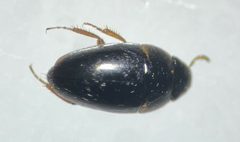
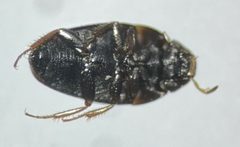
2Limnebius is a of minute moss beetles in the Hydraenidae, containing over 160 described . The genus exhibits uniform external but highly variable male genitalia, ranging from curved rod shapes in the subgenus Bilimneus to complex structures with up to seven longitudinal folds or appendages in Limnebius s.str. Species occur across multiple continents including Europe, Africa, Australia, and Papua New Guinea. The genus has been extensively studied for its morphological diversification and patterns of .
Pronunciation
How to pronounce Limnebius: //lɪmˈneɪbiʊs//
These audio files are automatically generated. While they are not always 100% accurate, they are a good starting point.
Identification
identification requires examination of male genitalia, particularly the . External is remarkably uniform across species, making dissection necessary for reliable determination. Some closely related species can only be distinguished by subtle differences in the aedeagus, such as L. agnieszkae from L. stagnalis.
Images
Habitat
Aquatic environments; specific microhabitat preferences vary by . Associated with water bodies where other water beetles occur. The subgenus distinction in wing structure suggests possible -related differences in capability.
Distribution
Widespread across multiple continents including Europe (including Crimean Peninsula, Spain), southern Africa (Namibia, South Africa, Zambia, Zimbabwe, southern Angola), Australia, and Papua New Guinea. Eleven documented from southern Africa alone. Distribution records also from Denmark, Norway, Sweden, and Vermont, USA.
Similar Taxa
- Other Hydraenidae generaLimnebius can be distinguished from other hydraenid by the combination of uniform external with highly variable male genitalia, and by subgeneric wing structure differences
More Details
Sexual dimorphism
The exhibits male-biased with higher evolutionary lability of male body size. Secondary sexual characters in male external have appeared multiple times independently, generally in that had already increased in size. There is significant correlation between sexual size dimorphism, male body size, and male genital size and complexity, though exceptions exist.
Taxonomic subdivisions
The contains two subgenera: Bilimneus, with simpler male genitalia and different wing structure, and Limnebius s.str., with complex male genitalia including up to seven longitudinal folds or appendages. groups within Limnebius s.str. include the L. parvulus group and L. nitidus group, with the L. parvulus group showing gradual increase in aedeagal elements.
Sources and further reading
- BugGuide
- GBIF taxonomy match
- iNaturalist taxon
- NCBI Taxonomy
- Catalogue of Life
- Limnebius (Limnebius) agnieszkae sp. n. from the Crimean Peninsula (Coleoptera: Hydraenidae)
- Taxonomy of the water beetle genus Limnebius Leach in southern Africa (Coleoptera: Hydraenidae)
- Limnebius acupunctus, a new species of water beetle from Australia and Papua New Guinea (Coleoptera: Hydraenidae)
- Table 6: Kolmogorov–Smirnov test of fit to a normal distribution of the phenotypic change and darwins (considering the sign of the change) for all and terminal branches, and for Bilimneus and Limnebius s.str.
- Revision of the Limnebius nitidus (Marsham) subgroup (Coleoptera: Hydraenidae), with description of two new species and comments on their phylogeny and biogeography
- Morphological diversification with emphasis on the structural and homology patterns of male genitalia in genus Limnebius (Leach 1815; Hydraenidae: Coleoptera)
- Evolution of sexual dimorphism and Rensch’s rule in the beetle genus Limnebius (Hydraenidae): is sexual selection opportunistic?