
Colon megasetosum
Peck & Stephan, 1996
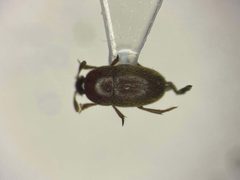
Colon megasetosum is a small round fungus beetle described by Peck & Stephan in 1996. It belongs to the Colon, a group of beetles commonly associated with fungal substrates. The has been documented across eastern and central North America, with records from Canada and the United States.
Pronunciation
How to pronounce Colon megasetosum: /kəˈloʊn ˌmɛɡəˈsiːtəsəm/
These audio files are automatically generated. While they are not always 100% accurate, they are a good starting point.
Images
Distribution
Eastern and central North America. Canadian records: Ontario, Quebec. United States records: Alabama, Arkansas, District of Columbia, Florida, Georgia, Kentucky, North Carolina, New Hampshire, Ohio, Pennsylvania, South Carolina, Virginia, Vermont, Wisconsin, West Virginia.
More Details
Taxonomic note
assignment varies in sources: GBIF lists Colonidae as the family, while iNaturalist and Wikipedia list Leiodidae. Leiodidae is the currently accepted family in modern classifications, with Colonidae sometimes treated as a (Coloninae) within Leiodidae.
Etymology
The specific epithet 'megasetosum' derives from Greek 'mega-' (large) and Latin 'setosum' (bristly/hairy), likely referring to conspicuous setae on the body.
Sources and further reading
- BugGuide
- Wikipedia
- GBIF taxonomy match
- iNaturalist taxon
- In the News: Hammock and Zhang Labs Target Obesity-Enhanced Colon Cancer | Bug Squad
- Why Timing Is Everything in Bumble Bee Colonies | Bug Squad
- Architectural Structure of Collapsed Feral Bee Colony Saved for UC Davis Public Display | Bug Squad
- A Termite-Control Twofer: How Baiting One Colony of Formosan Subterranean Termites Can Knock Out the Colony Next Door
- Short Bait Exposure Controls Asian Subterranean Termite Colonies
- Colony Size Drives Honey Bees' Overwinter Survival