
Colonidae
Horn, 1880
Genus Guides
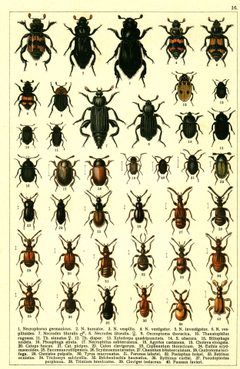
1Colonidae is a small of beetles in the superfamily Staphylinoidea, commonly known as colon beetles. The family contains approximately 50 described in the single *Colon*. These beetles are small, compact, and primarily associated with decaying organic matter and fungi. They are closely related to the rove beetles (Staphylinidae) but are distinguished by their more rounded body form and reduced that still cover most of the .
Pronunciation
How to pronounce Colonidae: //kəˈloʊ.nɪˌdaɪ//
These audio files are automatically generated. While they are not always 100% accurate, they are a good starting point.
Identification
Colonidae can be distinguished from the closely related Staphylinidae (rove beetles) by their more compact, less elongate body shape and that cover most or all of the , leaving at most one or two tergites exposed. Unlike most Staphylinidae, which have very short elytra exposing most of the abdomen, Colonidae have a more rounded, less parallel-sided body form. The are thread-like and of moderate length. The beetles are small, usually 2–5 mm in length, with a dark, often shiny coloration.
Images
Habitat
in this are found in decaying plant matter, fungi, and other decomposing organic substrates. They are particularly associated with rotting wood, leaf litter, and fungal fruiting bodies in forested environments.
Distribution
Colonidae has a primarily Holarctic distribution, with occurring in North America, Europe, and Asia. The is absent from tropical regions and the Southern Hemisphere.
Ecological Role
Members of this are presumed to function as decomposers in forest , contributing to the breakdown of decaying organic matter and fungi. Their specific ecological interactions remain poorly documented.
Human Relevance
Colonidae has no known economic importance to humans. The beetles are rarely encountered due to their small size and cryptic habits, and they are not considered pests or beneficial organisms in agriculture or forestry.
Similar Taxa
- StaphylinidaeRove beetles share the superfamily Staphylinoidea and have similar general body plans, but differ in having much shorter that expose most of the and a more elongate, parallel-sided body form.
- LeiodidaeRound fungus beetles share preferences for decaying matter and fungi, and have similar compact body shapes, but belong to a different superfamily (Staphylinoidea vs. Staphylinoidea for Colonidae—actually both in Staphylinoidea; Leiodidae can be distinguished by different antennal structure and typically more convex body form).
More Details
Taxonomic history
The Colonidae was established by Horn in 1880. Historically, these beetles were often treated as a (Coloinae) within Staphylinidae. Their elevation to family rank reflects recognition of their distinct morphological characteristics and phylogenetic position within Staphylinoidea.
Research status
Colonidae is among the least studied . Basic natural history information—including larval , detailed associations, and feeding —remains largely unknown for most .