
Necrophilus hydrophiloides
Guérin-Méneville, 1834
flat brown scavenger beetle
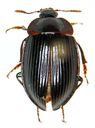
Necrophilus hydrophiloides is a of in the Agyrtidae, commonly known as the flat brown scavenger . It belongs to a relict lineage of beetles that represent an early-diverging branch of the staphylinoid beetles. The species is found in western North America, where it inhabits moist forest and is associated with carrion and decaying organic matter.
Pronunciation
How to pronounce Necrophilus hydrophiloides: /nɛˈkrɒfɪləs haɪˌdrɒfɪˈlɔɪdiːz/
These audio files are automatically generated. While they are not always 100% accurate, they are a good starting point.
Identification
Distinguished from other Agyrtidae by its flattened, oval body form and uniformly brown coloration. The Necrophilus is separated from related genera by antennal structure and pronotal shape. Within its range, it may be confused with small staphylinid beetles, but differs in having that completely cover the and a more compact body plan.
Images
Habitat
Moist forest environments, particularly in coniferous and mixed woodlands. Associated with decaying organic matter including carrion, fungi, and other decomposing substrates in cool, humid microhabitats.
Distribution
Western North America: Canada (British Columbia), United States (Alaska, California, Oregon, Washington).
Similar Taxa
- Small Staphylinidae (rove beetles)Share similar size and preferences, but rove beetles have abbreviated exposing most of the and more elongate body form.
- Silphidae (carrion beetles)Ecologically similar in carrion association, but Silphidae generally have more pronounced color patterns, larger size, and different antennal club structure.
More Details
Taxonomic position
Agyrtidae, including Necrophilus, are considered a primitive lineage within Staphylinoidea, representing one of the earliest-diverging branches of this large group. Their retains plesiomorphic features that help illuminate the evolutionary history of rove beetles and their relatives.
Conservation status
Not formally assessed. The relict distribution and specialized requirements suggest potential sensitivity to habitat disturbance, though specific threats have not been documented.