
Nyholmia confusa
(Brown, 1930)
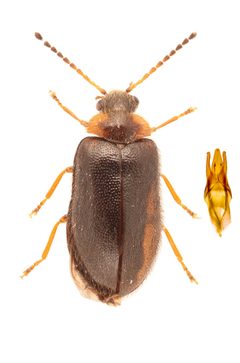
Nyholmia confusa is a of marsh beetle in the Scirtidae. The species was originally described by Brown in 1930 under the Cyphon as Cyphon confusus, and has since been reclassified under the genus Nyholmia. It is known from eastern North America, with records from Canada including New Brunswick, Newfoundland, Nova Scotia, and Ontario. Like other members of Scirtidae, this species is associated with moist or aquatic environments.
Pronunciation
How to pronounce Nyholmia confusa: /niːˈhɔlmiːə kənˈfjuːsə/
These audio files are automatically generated. While they are not always 100% accurate, they are a good starting point.
Images
Habitat
Associated with marshy or moist , consistent with the 'marsh beetle' applied to members of the Scirtidae. Specific microhabitat preferences for this are not documented.
Distribution
Eastern North America. Documented from Canadian provinces: New Brunswick, Newfoundland, Nova Scotia, and Ontario. Distribution in the United States, if present, is not clearly established in available sources.
Similar Taxa
More Details
Taxonomic History
Originally described as Cyphon confusus Brown, 1930. Later transferred to the Nyholmia, though GBIF currently lists it as a synonym of Cyphon confusus, indicating ongoing taxonomic uncertainty or alternative classification schemes in use.
Data Availability
This is extremely poorly documented in the literature. Only one observation is recorded in iNaturalist, and no detailed biological studies have been identified. Most aspects of its remain unknown.
Sources and further reading
- BugGuide
- Wikipedia
- GBIF taxonomy match
- iNaturalist taxon
- UC Davis-Based Projects: To Bee or Not to Bee? | Bug Squad
- Diversity of Bugs at Bohart Museum of Entomology | Bug Squad
- ZooKeys with 5 of the Top 10 Marine Species | Blog
- Interview: description of two African shovel-snout snakes from Angola
- Year of the Snake: a serpent selection to celebrate Lunar New Year!