
Trox variolatus
Melsheimer, 1845
hide beetle
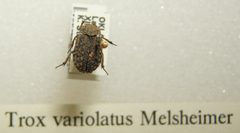
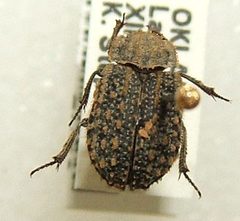
Trox variolatus is a hide beetle in the Trogidae, occurring across North America from Canada through the United States to Mexico. Like other members of its , it specializes in consuming dried animal remains, including skin, fur, feathers, and connective tissue during the final stages of decomposition. The is typically covered in debris, making it cryptic and difficult to detect.
Pronunciation
How to pronounce Trox variolatus: /ˈtɾɔks ˌvaɾi.oˈlaː.tus/
These audio files are automatically generated. While they are not always 100% accurate, they are a good starting point.
Identification
Trox are challenging to distinguish from one another without detailed examination. They are characterized by rough, heavily sculptured and a habit of becoming encrusted with debris. When disturbed, they adopt a rigid, death-feigning posture. Specific identification of T. variolatus requires examination of subtle morphological features not readily visible in the field.
Images
Habitat
Found in environments where dried animal remains accumulate, including carcasses in advanced decomposition, mummified carcasses, and coyote scat containing fur. Associated with terrestrial across its range where vertebrate mortality occurs.
Distribution
North America: United States (Florida, Indiana, Iowa, Kansas, Kentucky, Maryland, Nebraska, Oklahoma, Pennsylvania, South Carolina, Texas, Vermont, Virginia, Wisconsin), Canada (New Brunswick, Nova Scotia, Ontario, Prince Edward Island, Quebec), and Mexico (Colima, Durango, Hidalgo, Michoacán, Nuevo León, Veracruz).
Diet
and larvae feed on dried skin, fur, feathers, and connective tissue from vertebrate carcasses. Has been observed on coyote scat containing prey fur, which apparently serves as a substitute for dried carrion.
Life Cycle
Larval development occurs within or near dried animal remains. Specific details of -laying , larval instars, and sites for this are not documented.
Behavior
When disturbed, individuals freeze in a rigid, random posture and remain motionless for extended periods—death-feigning so convincing that specimens may be mistaken for dead. are often heavily coated in debris from their food source, rendering them nearly unrecognizable as insects.
Ecological Role
decomposer that processes recalcitrant keratinous materials (skin, hair, feathers) during late-stage carcass decomposition, facilitating nutrient return to the after most other carrion insects have departed.
Human Relevance
Harmless to humans; does not infest living animals or fresh carcasses. Of potential interest in as an indicator of extended postmortem interval when remains are desiccated.
Similar Taxa
- Trox sonoraeAnother North American hide beetle with similar and ; both occur on dried carcasses and exhibit death-feigning when disturbed. T. sonorae has been documented at 8–11 mm, providing a size reference point for the .
- Dermestes spp.Skin beetles in Dermestidae also occur on dried carcasses and bones, but differ in having clubbed , smoother bodies, and larvae that are conspicuously hairy. Dermestids often have patterned or metallic coloration, unlike the debris-encrusted, uniformly dull Trogidae.
More Details
Taxonomic note
The infraspecific name Trox variolatus monticola Robinson, 1940 is considered a synonym of T. variolatus.