
Trox unistriatus
Palisot de Beauvois, 1818
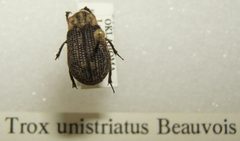
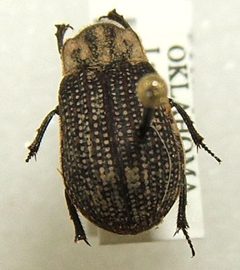
Trox unistriatus is a hide beetle in the Trogidae, a group closely related to scarab beetles. Like other members of its , this specializes in consuming dried animal remains, including skin, hair, feathers, and connective tissue. It is found across much of North America, with records from Canada and the United States. The species exhibits typical trogid : freezing in a rigid posture when disturbed and accumulating debris on its body for camouflage.
Pronunciation
How to pronounce Trox unistriatus: /trɔks juː.niˈstraɪ.eɪ.təs/
These audio files are automatically generated. While they are not always 100% accurate, they are a good starting point.
Images
Habitat
Found in association with dried animal remains, including carcasses in advanced stages of decay, bones, and mummified carcasses. Has been observed on coyote scat containing fur from prey animals, suggesting use of alternative substrates that provide similar nutritional resources. Occupies terrestrial environments across its range, from prairie to forested areas.
Distribution
Nearctic region. Recorded from Canada (Alberta, Manitoba, New Brunswick, Newfoundland, Nova Scotia, Ontario, Prince Edward Island, Quebec, Saskatchewan) and the United States (Colorado, Florida, Indiana, Iowa, Louisiana, Maryland, Nebraska, North Carolina, North Dakota, South Carolina, Texas, Virginia, Wisconsin).
Diet
Consumes dried skin, hair, feathers, fur, and connective tissue from animal carcasses in terminal stages of decomposition. and larvae feed on the same substrates.
Life Cycle
Larvae develop within or adjacent to dried carcass material, feeding on keratinous tissues. occurs in soil. Specific developmental details for this are not documented.
Behavior
When disturbed, individuals freeze in a rigid, random posture—a known as or death-feigning. The body becomes covered in debris, rendering the nearly unrecognizable as an insect. This camouflage and immobility likely serve as anti- defenses.
Ecological Role
Specialized decomposer that processes recalcitrant keratinous materials (hair, feathers, skin) that persist after most other carrion insects have departed. Represents a terminal stage in carcass decomposition .
Human Relevance
Of potential interest in for estimating time since death in cases involving skeletonized or mummified remains. May occasionally enter human dwellings when attracted to animal remains or dried animal products. Generally considered harmless and not a pest of stored products or structures.
Similar Taxa
- Trox sonoraeAnother small North American Trox (8-11 mm) with similar and ; distinguished by subtle morphological differences in pronotal and elytral
- Dermestes spp.Skin beetles in Dermestidae also consume dried animal remains and may co-occur on carcasses; distinguished by more elongate body form, clubbed , and different larval
More Details
Taxonomic Note
Authority sometimes cited as Beauvois, 1805 or Palisot de Beauvois, 1818; GBIF accepts Palisot de Beauvois, 1818