
Trox tuberculatus
Palisot de Beauvois, 1818
hide beetle
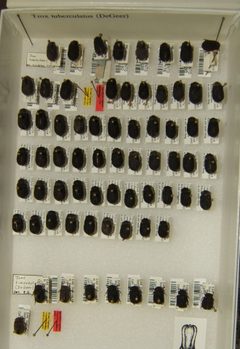
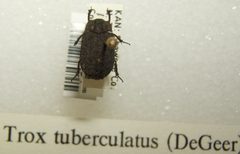
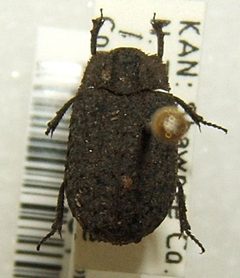
Trox tuberculatus is a hide beetle in the Trogidae, a group of scarabaeoid beetles specialized in feeding on dried animal remains. The occurs in the Nearctic region, with records from multiple U.S. states. Like other Trogidae, it is associated with the late stages of carcass decomposition, consuming dried skin, hair, feathers, and connective tissue. The exhibits characteristic defensive including (death-feigning) and debris-covering that render it cryptic and difficult to detect.
Pronunciation
How to pronounce Trox tuberculatus: /trɒks tjuːbərkjuːˈleɪtəs/
These audio files are automatically generated. While they are not always 100% accurate, they are a good starting point.
Images
Distribution
Nearctic region: United States (Arizona, Colorado, Florida, Indiana, Iowa, Kansas, Maryland, Massachusetts, Nebraska, New Mexico, South Carolina, Texas, Wyoming)
Diet
Dried animal skin, hair, feathers, fur, and connective tissue from mummified carcasses; has been observed on coyote scat containing undigested prey hair
Behavior
When disturbed, individuals become immobile in a rigid, random posture (), remaining unresponsive for extended periods. frequently cover themselves with debris from their surroundings, becoming nearly indistinguishable from substrate.
Ecological Role
Decomposer specializing in late-stage carcass decomposition; consumes desiccated animal materials that most other carrion insects cannot utilize.
Similar Taxa
- Trox sonoraeBoth are Nearctic hide beetles of similar size (8-11 mm) and preference; T. sonorae is specifically documented from Colorado and the southwestern U.S., overlapping with T. tuberculatus range. Differentiation requires examination of tuberculation patterns and male genitalia.
- Dermestes spp.Dermestid beetles also occur on dried carcasses and bones, but have clubbed , smoother body surfaces, and lack the pronounced and debris-covering habits of Trogidae.
Sources and further reading
- BugGuide
- Wikipedia
- GBIF taxonomy match
- iNaturalist taxon
- NCBI Taxonomy
- Catalogue of Life
- Bembicid Holdings | Entomology Research Museum
- How Do You Weigh a Bumble Bee? Ask UC Davis Entomologists and Engineers | Bug Squad
- Bug Eric: Honey, I lost the Trox
- Cretonthophilus tuberculatus Archives - Entomology Today
- Bug Eric: What's in Dat Scat?
- Bug Eric: More Beetles from Bones
- Description of a new Palaearctic Trox Fabricius species (Coleoptera: Trogidae) from Thailand, with a review of the Trox opacotuberculatus species-group and its biogeography