
Trox aequalis
Say, 1832
Even Hide Scarab Beetle
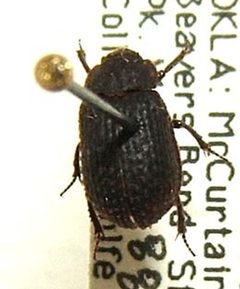
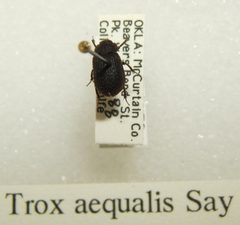
Trox aequalis is a hide beetle in the Trogidae, distributed across much of North America from northern Mexico through the United States to Canada. As a member of the Trogidae, it is associated with decomposing animal remains, particularly dried carcasses, skin, and bones. The was described by Thomas Say in 1832.
Pronunciation
How to pronounce Trox aequalis: //trɒks ɛˈkwɑːlɪs//
These audio files are automatically generated. While they are not always 100% accurate, they are a good starting point.
Images
Distribution
North America: United States (Arizona, Colorado, Georgia, Indiana, Iowa, Louisiana, Maryland, Nebraska, New York, North Dakota, South Carolina, South Dakota, Texas, Virginia, Wisconsin), Canada (Manitoba, New Brunswick, Nova Scotia, Ontario, Quebec, Saskatchewan), and Mexico (Chihuahua, Coahuila, Durango, Nuevo León, Morelos, Veracruz).
Diet
and larvae feed on dried animal remains, including skin, bones, feathers, fur, and connective tissue. They are among the final colonizers of carcasses, arriving after most other insects have departed.
Behavior
are cryptic, typically caked in debris that renders them nearly unrecognizable as insects. When disturbed, they exhibit (death-feigning), freezing in a rigid posture that makes them appear as inanimate objects.
Ecological Role
Decomposer; contributes to the final stages of carcass decomposition by consuming dried keratinous tissues and connective material that other carrion insects cannot utilize.
Human Relevance
Has forensic significance as an indicator of advanced decomposition stages. May occasionally be found in dried animal products or taxidermy materials.