
Onthophagus orpheus
(Panzer, 1794)
Green-bronze Dung Beetle
Species Guides
1Onthophagus orpheus is a dung beetle in the Scarabaeidae, abundant in urban forests of the eastern United States. Males possess prominent thoracic horns used in combat for access to females, with horn size varying continuously across individuals. The has been extensively studied for its dynamics and serves as a model for urban in insects. A high-quality assembly has been published to support research on behavioral and genetics.
Pronunciation
How to pronounce Onthophagus orpheus: //ɒnˈθɒfəɡəs ˈɔːrfiəs//
These audio files are automatically generated. While they are not always 100% accurate, they are a good starting point.
Identification
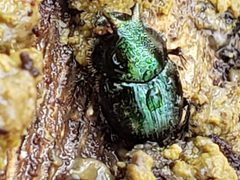
Distinguished from similar Onthophagus by its metallic green-bronze coloration and small size (6-9 mm). Males are readily identified by the thoracic horn; females may require examination of genitalia or comparison with sympatric species. In the eastern United States, it overlaps with Onthophagus hecate, which is similarly small but differs in horn and coloration. Continuous horn size variation in males, rather than discrete major/minor morphs, is a notable characteristic of this species.
Images
Habitat
Urban forests and green spaces in cities. Documented from forested areas with mammal activity, including parks and arboreta. Requires access to fresh for . Tunnels beneath the soil surface in association with dung deposits.
Distribution
Eastern United States and southeastern Canada. Documented from Massachusetts and surrounding regions; range extends broadly across eastern North America based on GBIF records and iNaturalist observations.
Seasonality
Active throughout the summer breeding season. Pitfall trap studies indicate peak activity during warmer months when resources are abundant and soil conditions permit tunneling.
Diet
Feeds on fresh mammal . process dung material for consumption; larvae develop within balls formed from dung.
Life Cycle
Females construct balls from pieces pulled into underground tunnels by males. Each brood ball receives a single . Larvae develop within the brood ball, feeding on the dung matrix. Development occurs entirely underground.
Behavior
Males engage in combat within tunnels to defend access to females. Fighting involves using thoracic horns to hook, push, and dislodge rival males. Horn size determines fighting strategy: larger males push and block, while smaller males may tunnel around competitors to sneak access to females. Females outnumber males throughout the season, yet male-male competition remains intense. Both sexes fly to locate fresh resources.
Ecological Role
Nutrient recycling through burial. Aerates soil through tunneling activity. May contribute to control by removing dung from the surface. Serves as a model organism for studying services in urban environments.
Human Relevance
Contributes to waste decomposition in urban parks and green spaces. Potential for urban health. Subject of scientific research on and urban . No known pest status.
Similar Taxa
- Onthophagus hecateOverlaps in range and ; distinguished by smaller size, different horn shape in males, and less pronounced metallic coloration
- Other Onthophagus speciesMany sympatric share dung beetle habits; require examination of coloration, size, and male horn for separation
More Details
Sexual selection research
Erin McCullough and colleagues at Clark University have studied in urban , documenting that males fight fiercely despite female-biased sex ratios, challenging assumptions about when exaggerated male traits evolve.
Genomic resources
A high-quality draft assembly was published in 2026, providing resources for behavioral and genetics research.
Subspecies
Three recognized: O. o. orpheus (nominate), O. o. canadensis, and O. o. pseudorpheus, though their validity and distributions require further study.
Sources and further reading
- BugGuide
- Wikipedia
- GBIF taxonomy match
- iNaturalist taxon
- NCBI Taxonomy
- Battles Beneath the City Park: What Urban Dung Beetles Reveal About Sexual Selection
- By Recycling Leftover Genes, Beetles Make New Horns and Eyes
- dung beetle | Blog
- How to Make a Four-Eyed Beetle
- Bug Eric: More Beetles from Bones
- ecology | Blog - Part 16
- Draft genome assembly of the green-bronze dung beetle, Onthophagus orpheus