
Melanocanthon bispinatus
(Robinson, 1941)
tumble bug
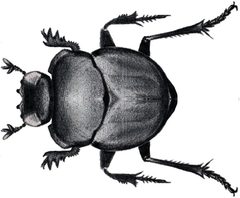
Melanocanthon bispinatus, commonly known as the tumble , is a dung beetle in the Scarabaeidae. The occurs across eastern North America. It is one of approximately 20 species in the Melanocanthon, which are small to medium-sized dung beetles. The 'tumble bug' reflects its of rolling balls.
Pronunciation
How to pronounce Melanocanthon bispinatus: /ˌmɛlənoʊˈkænθɒn baɪˈspaɪnətəs/
These audio files are automatically generated. While they are not always 100% accurate, they are a good starting point.
Identification
Small dung beetle in the tribe Deltochilini. Distinguished from related by characters of the genus Melanocanthon, including specific pronotal and elytral features. The specific epithet 'bispinatus' refers to two spines, likely on the tibiae or other appendages. Separation from other Melanocanthon requires examination of male genitalia and detailed morphological characters.
Images
Habitat
Found in areas with mammalian herbivore availability. Occurs in open and forested across its range. Associated with pasture, grassland, and woodland edge environments where ungulate dung accumulates.
Distribution
Eastern North America. Recorded from Ontario, Canada and the eastern United States: Alabama, Connecticut, Delaware, Florida, Georgia, Indiana, Maryland, Michigan, Mississippi, New Jersey, New York, North Carolina, Ohio, South Carolina, Tennessee, Virginia, and West Virginia.
Seasonality
have been recorded from March through October, with peak activity during warmer months. Most iNaturalist observations occur from May through September.
Diet
of mammalian herbivores, particularly ungulates. Feeds on dung as both and larva.
Life Cycle
Complete with , larva, pupa, and stages. Larvae develop within balls or dung masses constructed by adults. Specific developmental duration unknown.
Behavior
Rolling : form into balls and roll them away from deposition sites for burial and consumption. This 'tumbling' action gives the its . Both sexes participate in dung ball construction and burial.
Ecological Role
burial accelerates nutrient cycling and reduces dung accumulation on pasture surfaces. Activity contributes to soil aeration and reduces for pest flies that breed in dung.
Human Relevance
Beneficial in agricultural settings through removal. May contribute to reduced fly pest in livestock operations. No known negative economic impacts.
Similar Taxa
- Canthon speciesOther 'tumble ' in the tribe Deltochilini with similar rolling . Canthon generally larger and with different pronotal shapes.
- Other Melanocanthon speciesApproximately 20 in North America, distinguished by subtle morphological differences in genitalia and external characters.
More Details
Taxonomic note
Placed in tribe Deltochilini (formerly Canthonini), a group of small to medium dung beetles characterized by rolling . The Melanocanthon was revised by Robinson in 1941, who described this .
Observation frequency
Relatively well-documented on citizen science platforms with over 250 iNaturalist observations, suggesting it is not rare within its range.