
Canthidium
Erichson, 1847
Species Guides
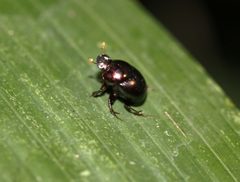
1Canthidium is a of small dung beetles in the Scarabaeidae, containing at least 170 described . Species in this genus are primarily neotropical and exhibit a characteristic "sit and wait" foraging strategy, perching on leaves to detect through chemoreception. They are classified as tunnelers, constructing burrows beneath dung deposits. Their small body size (often under 10 mm) influences their foraging and resource partitioning strategies within diverse dung beetle .
Pronunciation
How to pronounce Canthidium: /kænˈθɪdiəm/
These audio files are automatically generated. While they are not always 100% accurate, they are a good starting point.
Identification
Canthidium are distinguished from similar small dung beetles by their tunneler combined with small size (typically 5–10 mm). They differ from rollers (e.g., Canthon) by lacking the elongated hind legs adapted for rolling balls. They differ from larger tunnelers (e.g., Oxysternon, which exceeds 20 mm) by their diminutive size. Within the , species identification requires examination of genitalia and subtle morphological features not reliably distinguishable from external characters alone.
Images
Habitat
Primarily tropical and subtropical forests of the Neotropical region. Associated with forested where mammal resources are available. Perches on vegetation at heights ranging from 3 to 250 cm above ground, with perching height influenced by body size and competitive interactions.
Distribution
Neotropical region, with greatest diversity in Central and South American tropical forests. Specific range boundaries for the as a whole are not comprehensively documented.
Diet
Feeds on mammal ; specific dietary preferences among dung types have not been documented for the .
Behavior
Exhibits "sit and wait" perching : individuals position on leaves facing into wind with raised and extended to detect olfactory cues from . Forelegs tucked under prothorax, hind legs spread alongside body. This strategy reduces energy expenditure compared to active searching and functions as resource partitioning to avoid competition with larger, actively foraging dung beetle .
Ecological Role
Contributes to decomposition and nutrient cycling in tropical . As small tunnelers, they bury dung fragments, facilitating soil aeration and nutrient incorporation. Their perching at specific heights reduces , promoting coexistence within -rich dung beetle .
Human Relevance
Potential indicator for health in tropical forests; sensitivity to disturbance has been suggested but not rigorously tested. No documented direct economic importance.
Similar Taxa
- CanthonSimilar small size and neotropical distribution, but Canthon are rollers with modified hind legs for ball formation, whereas Canthidium are tunnelers.
- OxysternonBoth are tunnelers in Scarabaeidae, but Oxysternon are substantially larger (>20 mm versus <10 mm) and actively follow animals rather than perching.
- EurysternusSimilar neotropical tunneler guild, but Eurysternus are medium-sized dwellers (around 15 mm) with different foraging and body proportions.
More Details
Perching Behavior Research
Perching in Canthidium was specifically documented in Canthidium splendidum (6.2 mm female) by Noriega and Vulinec (2020). The was first recorded circa 1900 and represents a spatial segregation mechanism to dilute . Only five studies have directly addressed this behavioral hypothesis, indicating substantial knowledge gaps.
Taxonomic Uncertainty
With at least 170 described , Canthidium is species-rich, but many species likely remain undescribed. Species-level identification is challenging and often requires examination.