
Gnorimella maculosa
(Knoch, 1801)
Maculated Scarab
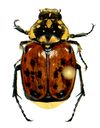
Gnorimella maculosa is a scarab beetle and the sole representative of its . It is characterized by spotted elytral patterning that gives the its name. The is associated with deciduous woodland in eastern North America. It is considered uncommon in collections and field observations.
Pronunciation
How to pronounce Gnorimella maculosa: /ɡnoˈrɪmɛlə mækjʊˈloʊsə/
These audio files are automatically generated. While they are not always 100% accurate, they are a good starting point.
Identification
The combination of spotted elytral patterning, moderate size (~15 mm), and association with eastern North American deciduous woodlands distinguishes this from similar cetoniine scarabs. It is the only species in the Gnorimella, which may be distinguished from related genera (e.g., Trichius) by subtle morphological characters of the scutellum and elytral , though precise diagnostic features are not detailed in available sources.
Images
Appearance
Approximately 15.2 mm in length. bear distinct spotted (maculate) patterning. Body form typical of flower chafers (Cetoniinae), with somewhat rounded, convex profile.
Habitat
Deciduous woodland and adjacent edge . Specific microhabitat preferences (e.g., level, ground stratum) are not documented in available sources.
Distribution
Eastern North America: Canada (New Brunswick, Nova Scotia, Ontario, Quebec) and United States (Alabama, Connecticut, District of Columbia, Florida, Georgia, Indiana, Iowa, Kansas, Kentucky, Louisiana, Maine, Maryland, Massachusetts, Michigan, Missouri, New Hampshire, New Jersey, New York, North Carolina, Ohio, Pennsylvania, Rhode Island, South Carolina, Tennessee, Texas, Virginia, West Virginia, Wisconsin).
Human Relevance
Occasionally encountered by entomologists and naturalists; 283 observations recorded on iNaturalist as of source date. No documented economic or agricultural significance.
Similar Taxa
- Trichius speciesOther eastern North American flower chafers share similar size and general body form, but differ in elytral pattern (often banded rather than spotted) and lack the specific maculate pattern of Gnorimella maculosa
- Other Cetoniinae generaGeneric placement requires examination of detailed morphological characters; Gnorimella is distinguished as
More Details
Taxonomic uniqueness
Gnorimella is a , making G. maculosa phylogenetically and taxonomically distinctive among New World Scarabaeidae