
Rhyssemus scaber
Haldeman, 1848
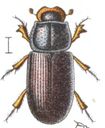
Rhyssemus scaber is a small aphodiine dung beetle in the Scarabaeidae, described by Haldeman in 1848. The is known from multiple states in the eastern and central United States. As a member of the Aphodiinae, it belongs to a group of beetles commonly associated with and decaying organic matter. The Rhyssemus contains species typically adapted to sandy or psammophilic .
Pronunciation
How to pronounce Rhyssemus scaber: /ˈrɪsɛməs ˈskeɪbər/
These audio files are automatically generated. While they are not always 100% accurate, they are a good starting point.
Identification
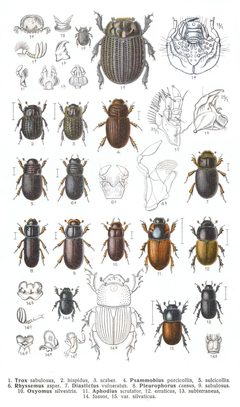
Members of the Rhyssemus are small, compact scarab beetles often with a somewhat cylindrical body form and reduced or modified wings. They are distinguished from other aphodiine genera by characteristics of the , legs, and male genitalia. R. scaber specifically can be separated from by subtle differences in surface sculpturing and body proportions, though precise diagnostic features require examination of type material and detailed taxonomic keys.
Images
Habitat
in the Rhyssemus are typically associated with sandy substrates, including coastal dunes, riverine sandbars, and other psammophilic environments. The specific microhabitat preferences of R. scaber have not been documented in detail, but related species are often found in sandy soils where they burrow and feed on organic matter.
Distribution
Documented from the eastern and central United States, including Colorado, Delaware, Maryland, New Jersey, New York, North Carolina, Rhode Island, and Virginia. A record from Florida requires verification. The occurs within the Nearctic biogeographic region.
Ecological Role
As an aphodiine dung beetle, R. scaber likely contributes to nutrient cycling and soil aeration through its feeding and burrowing activities in sandy substrates. The specific ecological functions of this have not been studied directly.
Similar Taxa
- Other Rhyssemus species share small size, cylindrical body form, and psammophilic habits. Distinguishing R. scaber requires examination of male genitalia and subtle differences in elytral sculpturing.
- Psammodius species (Psammodiini)Related tribe members share sandy preferences and similar body form. Differ in details of antennal club structure and male genitalia.
- Other Aphodiinae generaMany small aphodiines overlap in general appearance. Rhyssemus is distinguished by a combination of characters including the form of the , protibial teeth, and elytral .
More Details
Taxonomic history
The was described by Samuel Stehman Haldeman in 1848, an early American naturalist who contributed significantly to the description of North American insects. The specific epithet 'scaber' refers to a rough or scaly surface texture, likely describing the elytral sculpturing.
Collection records
GBIF and other aggregators list multiple state-level records, though precise locality data and descriptions are sparse. The appears to be infrequently collected relative to more common aphodiines, possibly reflecting its specialized sandy habitat preferences or true rarity.