
Teuchestes fossor
(Linnaeus, 1758)
gravedigger dung beetle
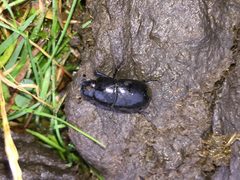
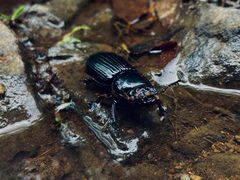
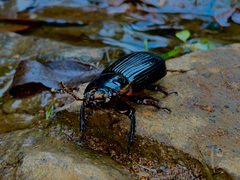
Teuchestes fossor is a dung beetle native to the Palaearctic region that has become widespread in North America following accidental introduction during European settlement. Both and larvae feed on herbivore , with adults consuming liquid fractions and larvae consuming fibrous material. The is readily collected from livestock dung and supports key services in cattle systems. It is one of the most frequently observed dung beetles in its range, with over 600 citizen science records.
Pronunciation
How to pronounce Teuchestes fossor: /teʊˈkɛstɛs ˈfɔsɔr/
These audio files are automatically generated. While they are not always 100% accurate, they are a good starting point.
Images
Habitat
Found in association with herbivore , particularly livestock dung and that of other large mammals. Occurs in agricultural landscapes, pastures, and natural grasslands where grazing mammals are present.
Distribution
Native to the Palaearctic region including Europe, North Africa, and temperate Asia from the British Isles east to Korea and south to North Africa. Introduced and naturalized throughout much of North America including Canada (Alberta, British Columbia, Labrador, Manitoba, New Brunswick, Newfoundland, Nova Scotia, Ontario, Prince Edward Island, Quebec, Saskatchewan) and the United States (Alaska, Colorado, Idaho, Iowa, Kansas, Maryland, Nebraska, New Mexico, North Dakota, South Dakota, Virginia, Wisconsin, Wyoming).
Diet
. feed on the liquid fraction of herbivore ; larvae feed on the fibrous fraction.
Ecological Role
Supports key services in cattle systems through burial and nutrient cycling. Differentiation of resource use between and larvae may reduce and enhance decomposition .
Human Relevance
Accidentally introduced to North America during European settlement. Now widespread and established in agricultural systems where it contributes to decomposition and pasture hygiene.
Sources and further reading
- BugGuide
- GBIF taxonomy match
- iNaturalist taxon
- Catalogue of Life
- Bug Eric: Fossorial Mason Wasps, genus Pterocheilus
- Bug Eric: Wasp Wednesday: Anacrabro ocellatus
- Bug Eric: March Flies in May
- Shining like a diamond: a new species of diamond frog from northern Madagascar | Blog
- Bug Eric: Wasp Wednesday: Great Golden Digger
- west africa | Blog