
Tetraclipeoides aemulus
(Horn, 1887)
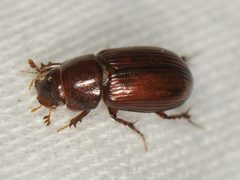
Tetraclipeoides aemulus is a scarab beetle in the Aphodiinae, described by Horn in 1887. It belongs to a of dung beetles distributed in arid and semi-arid regions of western North America. The is known from limited collection records in the southwestern United States and northern Mexico.
Pronunciation
How to pronounce Tetraclipeoides aemulus: /ˌtɛtɹəˌklaɪpiˈoʊdiz ˈiːmjələs/
These audio files are automatically generated. While they are not always 100% accurate, they are a good starting point.
Identification
Members of Tetraclipeoides are small to medium-sized aphodiine scarabs with compact bodies. Within the , T. aemulus may be distinguished by characters of the clypeal margin and pronotal shape, though specific diagnostic features require examination of and original description. The genus is characterized by a quadridentate and distinctive elytral striation patterns typical of the Aphodiina.
Images
Habitat
Arid and semi-arid environments including desert scrub and grassland of the southwestern United States and Chihuahuan Desert region.
Distribution
Southwestern United States (Arizona, New Mexico, Utah) and northern Mexico (Chihuahua).
Ecological Role
As a member of Aphodiinae, this likely functions as a dung beetle contributing to nutrient cycling and soil aeration through burial of herbivore , though specific ecological roles have not been documented.
Similar Taxa
- Tetraclipeoides spp.Other in the share the quadridentate and general body form; precise identification requires examination of male genitalia and clypeal details.
- Aphodiinae of similar sizeSmall aphodiines in the tribe Aphodiini may resemble T. aemulus externally; clypeal structure and geographic distribution help distinguish Tetraclipeoides from related such as Aphodius sensu lato.
More Details
Taxonomic history
Originally described in the Aphodius by George Henry Horn in 1887, this was later transferred to Tetraclipeoides as the genus was erected to accommodate species with distinctive clypeal . The genus Tetraclipeoides currently contains approximately 10 species, all restricted to the Nearctic and northern Neotropical regions.
Collection rarity
The is represented by very few specimens in collections, with only one observation recorded in iNaturalist as of the knowledge cutoff. This rarity may reflect genuine scarcity, cryptic habits, or under-sampling of its arid .