
Sinodendron rugosum
Mannerheim, 1843
Rugose Stag Beetle
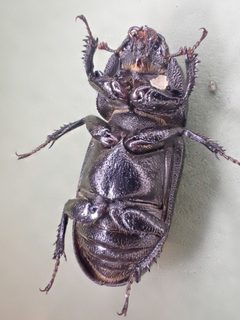
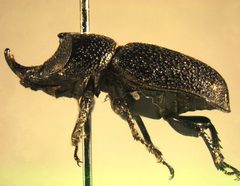
Sinodendron rugosum, the , is a small stag beetle and the only member of its in western North America. are black, 11–18 mm in length, with a distinctively pitted, rough-textured . Males possess a short horn on the , while females lack this structure or have only a small . The develops in decaying wood of broadleaf trees and is active as an adult from spring through early summer.
Pronunciation
How to pronounce Sinodendron rugosum: /ˌsɪnoʊˈdɛndrən ruˈgoʊsəm/
These audio files are automatically generated. While they are not always 100% accurate, they are a good starting point.
Identification
The combination of small size (under 20 mm), uniformly black coloration, and distinctly pitted/ and pronotum separates this from other western North American Lucanidae. The male's short horn and narrow head, versus the female's hornless or weakly tuberculate head, are diagnostic for the species. The non-opposable clubbed distinguish it from related . No other Sinodendron species occurs in western North America.
Images
Appearance
are uniformly black, 11–18 mm in length, with a conspicuously surface texture created by numerous small pits covering the pronotum and . are clubbed and non-opposable. is pronounced: males have a narrow bearing a short, , rhinoceros-like horn; females have a broader head with either no horn or a small median . Both sexes possess relatively small compared to other stag beetles.
Habitat
Moist woodlands, particularly areas with decaying wood of broadleaf trees. Larval development occurs in rotting wood of oak, alder, willow, and cherry. are frequently encountered on the ground in forested areas with suitable decaying wood substrate.
Distribution
Western North America: British Columbia, Canada south through Washington, Oregon, and Idaho to California, USA. It is the only of Sinodendron known from this region.
Seasonality
are active from spring through early summer. Larvae are present year-round within decaying wood.
Diet
Larvae feed on decaying wood of broadleaf trees, particularly oak, alder, willow, and cherry. have been observed feeding on plant juices and honeydew.
Host Associations
- Quercus - larval substrateoak
- Alnus - larval substratealder
- Salix - larval substratewillow
- Prunus - larval substratecherry
Life Cycle
are laid on bark. Larvae hatch and tunnel inward into decaying wood, where they feed and eventually construct pupal chambers. Development occurs entirely within decaying wood. emerge and are active above ground during spring and early summer.
Behavior
Males use their cephalic horn in combat with other males to establish dominance when competing for mates. are commonly found on the ground rather than flying.
Ecological Role
Larvae function as saproxylic decomposers, breaking down decaying wood of broadleaf trees and contributing to nutrient cycling in forest . The serves as prey for forest , including the Northern Spotted Owl (Strix occidentalis).
Human Relevance
No significant direct economic or medical importance. Occasionally encountered by naturalists and entomologists in western North American forests. Presence indicates mature woodland with decaying wood .
Similar Taxa
- Other Lucanidae (stag beetles)Most western North American stag beetles are larger, lack the pitting, or possess more developed rather than a cephalic horn. Pseudolucanus and other show different antennal and mandibular .
- Sinodendron cylindricumThis eastern North American is larger (15–25 mm), has a smoother, less pitted , and males have a more developed, differently shaped horn. Ranges do not overlap.
More Details
Taxonomic significance
Sinodendron rugosum represents the only western North American occurrence of the Sinodendron, which is otherwise primarily distributed in the Palearctic region with additional in eastern North America.
Conservation note
Dependent on mature forests with standing and fallen decaying wood; loss from logging and urbanization may impact local .