
Mycotrupes gaigei
Olson & Hubbell, 1954
North peninsular mycotrupes beetle
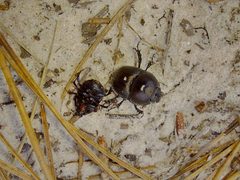
Mycotrupes gaigei is a flightless, earth-boring scarab beetle to deep sand ridges in northwestern peninsular Florida. It is considered the most morphologically aberrant member of its , characterized by metathoracic wing degradation and fusion of prothoracic elytrae. The is an efficient burrower, tunneling through sand to depths exceeding six feet. It maintains an exclusive phoretic relationship with the mite Geotrupacarus mycotrupetes, which does not occur on any other Mycotrupes species.
Pronunciation
How to pronounce Mycotrupes gaigei: /maɪkoʊˈtruːpiːz ˈɡaɪdʒiːaɪ/
These audio files are automatically generated. While they are not always 100% accurate, they are a good starting point.
Identification
Distinguished from other Mycotrupes by its restricted distribution in northwestern peninsular Florida and by the exclusive presence of the phoretic mite Geotrupacarus mycotrupetes. Flightlessness due to metathoracic wing degeneration and elytral fusion separates it from winged co-occurring geotrupids such as Geotrupes egeriei. Considered the most aberrant member of the Mycotrupes based on morphological characteristics.
Images
Habitat
Deep, well-drained sand ridges overlying porous limestone in northwestern peninsular Florida. Associated with xeric, open woodland dominated by turkey oak and bluejack oak, with clumps of seedling oaks, low shrubs, leaf litter, grasses, and herbs.
Distribution
Northwestern peninsular Florida, USA. Restricted to deep sand ridge ; with other Mycotrupes .
Diet
feeder utilizing , decaying fungi, plant litter, and exposed soft tissue of acorns. Accepts virtually any available organic food substrate.
Host Associations
- Geotrupacarus mycotrupetes - phoretic mite associateExclusive to M. gaigei among all five described Mycotrupes ; attaches preferentially behind I or in the gular area. Early derivative macrochelid mite not found on other Mycotrupes species despite their sympatric distributions.
- Geotrupes egeriei - co-occurring Winged geotrupid that co-occurs in Florida; strongly attractive to G. mycotrupetes in laboratory settings but has not expanded the mite's range beyond peninsular Florida.
Behavior
Efficient burrower, tunneling down through sand to depths exceeding six feet. Flightless, with restricted searching capacity due to wing loss. Molecular evidence suggests originated from southward of M. retusus from the Fall Line after late Pleistocene sea level changes.
Similar Taxa
- Mycotrupes retususOther Mycotrupes ; M. gaigei likely originated from southward of M. retusus ancestor. Separated by geography and (M. retusus occurs in Georgia/South Carolina sand hills).
- Geotrupes egerieiWinged geotrupid co-occurring in Florida; distinguished by capability and lack of exclusive mite association with G. mycotrupetes.
More Details
Evolutionary significance
Flightlessness in Mycotrupes arose early in the due to metathoracic wing degradation and fusion of prothoracic elytrae. M. gaigei represents a derived lineage that colonized Florida sand ridges following late Pleistocene sea level changes.
Mite specificity
The exclusive association with Geotrupacarus mycotrupetes is notable given that other Mycotrupes are sympatric with G. egeriei, which attracts the mite in laboratory conditions, yet the mite has not expanded its range to these other or beyond peninsular Florida.
Sources and further reading
- BugGuide
- Wikipedia
- GBIF taxonomy match
- iNaturalist taxon
- Catalogue of Life
- Notes on the New World allopatric beetle genus Mycotrupes (Scarabaeoidea: Geotrupidae) and on Geotrupacarus mycotrupetes (Krantz and Mellott) (Acari: Macrochelidae), an early derivative phoretic mite associate of Mycotrupes gaigei Olson and Hubbell in southeastern United States